Florida Trucking Company Liability: Holding Negligent Carriers Accountable
Florida trucking company liability law lets crash victims hold negligent carriers accountable for unsafe hiring, maintenance, and dispatch decisions.
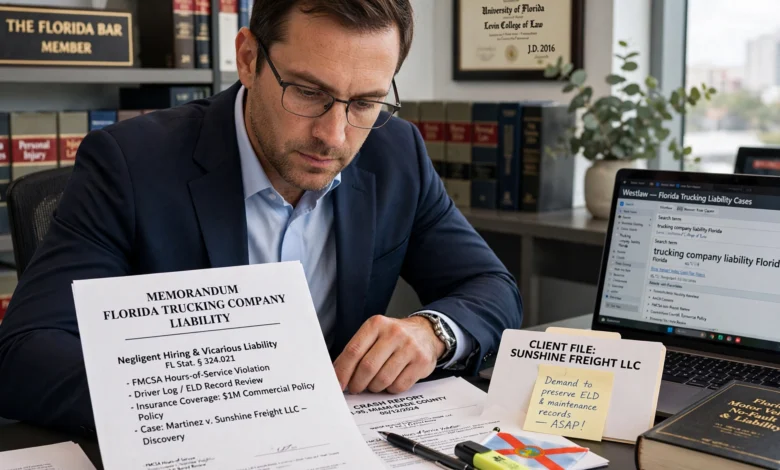
Florida trucking company liability is one of the most misunderstood areas of personal injury law, and that confusion costs crash victims real money. When most people picture a truck accident lawsuit, they picture one thing: the driver who was behind the wheel. But the driver is rarely the only party who should be named in a claim, and in a lot of cases, the driver isn’t even the most important one.
Commercial trucking is a business, and businesses make decisions long before a truck ever pulls onto I-95 or the Florida Turnpike. Someone decided to hire that driver despite a shaky safety record. Someone decided to skip a brake inspection to keep the truck on schedule. Someone decided a driver could handle one more run even though he’d already logged too many hours that week. When those decisions lead to a crash, the company behind them can be held just as responsible as the person who was driving.
This article breaks down how negligent carriers get held accountable under Florida law, who else might share the blame, what evidence actually wins these cases, and what compensation looks like when a trucking company’s own choices caused your injuries. Whether you’re trying to understand your options after a crash or just want to know how this corner of the law works, here’s what you need to know.
What Is Florida Trucking Company Liability?
Florida trucking company liability refers to the legal responsibility a motor carrier holds when its driver, its equipment, or its own business practices contribute to a crash. It covers two very different legal paths that often run side by side in the same case:
- Vicarious liability, where the company is on the hook for what its driver did while working
- Direct liability, where the company is on the hook for what it did (or failed to do) as a business
Florida is one of the busier trucking corridors in the country, with heavy freight traffic running through I-4, I-75, I-95, and the Florida Turnpike. That volume, combined with a large elderly and tourist population sharing the road, is part of why the state consistently ranks among the states with the highest number of fatal large-truck crashes. When a crash happens, figuring out who is liable for a truck accident in Florida usually means looking well past the driver’s seat.
1. Respondeat Superior: Why the Carrier Answers for the Driver
The first and most common path to trucking company liability is a legal doctrine called respondeat superior, a Latin phrase that roughly means “let the master answer.” Under this rule, an employer is legally responsible for the negligent acts of an employee committed within the scope of their job.
Applied to trucking, this means that if a driver ran a red light, followed too closely, or fell asleep at the wheel while making a delivery for the company, the motor carrier can be held liable for the resulting damages just as if it had caused the crash itself. The driver doesn’t need to have acted with any special malice, and the company doesn’t need to have known about the specific mistake in the moment. As long as the driver was working, respondeat superior generally applies.
This matters enormously for victims, because it changes where the money comes from. A driver’s personal auto policy might carry $25,000 to $50,000 in coverage, if that. A motor carrier, on the other hand, is required under federal law to carry substantially more.
Minimum Insurance Requirements for Interstate Carriers
Under 49 CFR § 387.9, the Federal Motor Carrier Safety Administration (FMCSA) requires interstate motor carriers to maintain at least $750,000 in liability insurance for general freight, and that minimum climbs to $1 million or more for carriers hauling hazardous materials. In practice, many large fleets carry $1 million to $5 million in primary coverage, often stacked with additional excess policies. Suing the driver alone caps recovery at whatever personal coverage they happen to carry. Suing the carrier is usually what unlocks meaningful compensation.


2. Direct Negligence Claims Against the Carrier
Respondeat superior isn’t the only tool available. Trucking companies can also be directly liable for their own conduct, separate from anything the driver did behind the wheel. These claims tend to be the most powerful ones in serious injury cases, because they point to a pattern of corporate decision-making rather than a single moment of driver error.
Negligent Hiring and Retention
Trucking companies are supposed to vet the people they put behind the wheel of an 80,000-pound vehicle. That means checking driving records, verifying commercial driver’s license (CDL) status, reviewing prior accident history, and confirming the driver meets FMCSA qualification standards. When a company hires or keeps a driver with a documented history of DUIs, repeated moving violations, or previous crashes, and that driver later causes an accident, the company can be held liable for negligent hiring and retention.
Negligent Maintenance
Carriers are responsible for keeping their fleets roadworthy. That includes:
- Performing required pre-trip and post-trip inspections
- Repairing known brake, tire, and steering defects promptly
- Complying with federally mandated inspection schedules
- Keeping accurate maintenance records for every vehicle in the fleet
When a company cuts corners on negligent maintenance, whether that’s delaying brake repairs to avoid downtime or ignoring a driver’s defect report, and a mechanical failure causes a wreck, the resulting claim often centers on internal maintenance logs and inspection reports rather than anything the driver could have controlled.
Failure to Enforce Hours-of-Service Rules
Driver fatigue is one of the leading causes of large truck crashes, which is exactly why the FMCSA enforces strict hours-of-service regulations limiting how long a driver can be on duty before resting. Companies are required to install electronic logging devices (ELDs) to track compliance. Some carriers, under pressure to hit tight delivery windows, pressure drivers to fudge their logs or push past legal limits anyway. When that pressure leads to a fatigue-related crash, it becomes powerful evidence of the company’s own negligence, not just the driver’s.
Negligent Cargo Loading
Improperly loaded or secured cargo can cause a truck to jackknife, roll over, or shed its load onto the highway. Responsibility for this can fall on the trucking company itself or on a third-party loading contractor, depending on who actually packed and secured the freight. Florida’s comparative negligence framework allows victims to pursue every party whose carelessness contributed to the crash, including a cargo loading company that never touched the truck’s controls.
3. When Carriers Try to Dodge Liability
Trucking companies and their insurers rarely accept blame without a fight, and one of their favorite defenses is claiming the driver was an independent contractor rather than an employee. The theory is simple: if the driver wasn’t technically an employee, the company argues it shouldn’t be vicariously liable for the driver’s mistakes.
Florida courts don’t automatically accept that label. Judges look at the real working relationship instead of what a contract says on paper, including:
- Who controlled the driver’s routes and schedule
- Who owned or leased the truck and trailer
- Who set the pay structure and delivery deadlines
- Who provided the training, uniforms, or branding on the vehicle
If the carrier controlled these day-to-day details, a court may still treat the driver as an employee for liability purposes, regardless of the paperwork. On top of that, federal regulations generally prevent interstate motor carriers from escaping vicarious liability for drivers operating under their DOT authority, even when those drivers are classified as independent contractors on paper.
4. Other Parties Who May Share the Blame
Truck crashes rarely trace back to one single failure. They’re usually the result of several smaller failures lining up at the worst possible time. Depending on the facts of your case, liability might extend beyond the driver and the carrier to include:
- Freight brokers – Companies that arrange shipments between shippers and carriers can face liability for negligently selecting an unsafe motor carrier with a known history of safety violations. A 2026 U.S. Supreme Court ruling in Montgomery v. Caribe Transport II, LLC clarified that brokers can’t automatically shield themselves from these safety-based negligence claims by pointing to federal preemption law.
- Maintenance contractors – Independent repair shops hired to service a fleet can be held liable when defective repair work leads to a mechanical failure and a crash.
- Cargo loading companies – Third-party warehouse operators or loading crews can share fault when improperly secured freight contributes to the accident.
- Truck and parts manufacturers – If a defective brake system, tire, or coupling device failed and caused the crash, a product liability claim against the manufacturer may be appropriate alongside the negligence claim against the carrier.
- Shippers – In some circumstances, the company that packed a trailer with improperly loaded or overweight freight can be independently liable.
Identifying every responsible party matters because it often means access to multiple insurance policies rather than just one, which becomes critical in cases involving catastrophic injuries or wrongful death.
5. Florida’s Comparative Negligence and Filing Deadlines
Florida used to follow a pure comparative negligence rule, but that changed. Florida now follows a modified comparative negligence standard, meaning an injured party can still recover damages as long as they’re found less than 51% at fault for the crash. If a jury finds a victim 20% responsible, their total award is reduced by that percentage. This matters in trucking cases because carriers and their insurers will often try to shift blame onto the victim to reduce their own exposure.
Florida also abolished traditional joint and several liability in most personal injury cases under Florida Statute § 768.81, meaning each defendant is generally only responsible for their own percentage of fault rather than the full judgment amount. That makes it even more important to name every negligent party in the lawsuit rather than assuming one deep-pocketed defendant will cover the whole judgment.
Statute of Limitations
Under Florida Statute § 95.11(5)(a), injury victims generally have two years from the date of the crash to file a negligence-based lawsuit against both the driver and the trucking company. Wrongful death claims carry their own separate two-year deadline running from the date of death. Missing this window typically means losing the right to sue entirely, so early legal action matters, particularly in trucking cases where evidence like electronic logging data and dashcam footage can be overwritten or destroyed within weeks of a crash if it isn’t formally preserved.
6. Punitive Damages Against Negligent Carriers
Most truck accident claims involve compensatory damages, covering medical bills, lost income, and pain and suffering. But in cases involving especially reckless conduct, Florida law also allows for punitive damages, which are designed to punish the wrongdoer and deter similar conduct in the future rather than simply compensate the victim.
To pursue punitive damages against a trucking company, a victim generally needs to show the company itself, not just the driver, engaged in intentional misconduct or gross negligence. Examples might include:
- Knowingly falsifying driver logs to hide hours-of-service violations
- Ignoring documented, repeated maintenance defects on a vehicle
- Continuing to dispatch a driver after multiple DUI convictions
- Pressuring drivers to exceed legal driving limits to meet delivery quotas
Florida law adds procedural hurdles here. Under Florida Statute § 768.72, a plaintiff can’t simply list punitive damages in the initial complaint. Instead, the case has to proceed through discovery first, and the plaintiff’s attorney has to file a motion asking the court for permission to add the claim, supported by a reasonable evidentiary basis. Florida also generally caps punitive damages at three times the compensatory award or $500,000, whichever is greater, though exceptions exist for particularly reckless conduct.
7. How to Build a Strong Case Against a Trucking Company
Proving Florida trucking company liability is a different animal than proving fault in an ordinary car accident case. Trucking companies typically have corporate legal teams, dedicated claims adjusters, and insurers that specialize in minimizing payouts. Matching that requires knowing exactly what evidence to look for and how quickly to secure it. Key sources of evidence include:
- Electronic logging device (ELD) data showing the driver’s actual hours behind the wheel
- Black box / event data recorder (EDR) data capturing speed, braking, and steering just before impact
- Driver qualification files, including background checks, CDL status, and prior violations
- Maintenance and inspection records for the specific truck involved
- Dispatch records and delivery schedules showing whether the driver was under pressure to speed or skip rest breaks
- Drug and alcohol testing records, since carriers are required to conduct random screening
- Dashcam or nearby surveillance footage from the truck or surrounding businesses
Because carriers know how damaging this evidence can be, some may be tempted to let it disappear. If litigation is reasonably anticipated, destroying relevant records can constitute spoliation of evidence, which courts can penalize and which juries can be instructed to treat as evidence of guilt. Sending a formal preservation letter early in a case is one of the simplest and most important steps an attorney can take.
What Compensation Can Victims Recover?
Victims of trucking company negligence can generally pursue both economic and non-economic damages, including:
- Current and future medical expenses, including surgery and rehabilitation
- Lost wages and reduced future earning capacity
- Property damage
- Pain and suffering
- Permanent impairment or disfigurement
- Wrongful death damages, including funeral costs and loss of companionship, for surviving family members
- Punitive damages in cases involving gross negligence or intentional misconduct
Because the injuries in commercial truck crashes tend to be more severe than those in ordinary car accidents, given the sheer size and weight difference between a passenger vehicle and a fully loaded semi, the value of these claims is often substantially higher. There’s no fixed formula or spreadsheet for calculating a settlement. Every case depends on the severity of the injuries, the amount of available insurance coverage, and the degree of recklessness involved.
Why Naming the Trucking Company Matters
Insurance adjusters often try to steer conversations toward the driver alone after a crash, and it’s not hard to see why that framing benefits the carrier. A driver’s personal insurance policy is almost always a fraction of what the company itself carries. Focusing a claim solely on the individual behind the wheel leaves significant compensation on the table.
Pursuing the trucking company, not just the driver, opens the door to larger insurance policies, independent legal theories like negligent hiring and negligent maintenance, and a broader pool of potentially responsible parties. According to the Federal Motor Carrier Safety Administration, motor carriers are required to comply with a detailed set of safety regulations covering everything from driver qualifications to vehicle maintenance, and violations of these regulations often serve as powerful evidence of negligence in a civil lawsuit.
Final Thoughts
Florida trucking company liability exists because the law recognizes something simple: crashes involving commercial trucks are rarely just about a driver’s split-second mistake. They’re often the end result of business decisions made weeks or months earlier, in a hiring office, a maintenance bay, or a dispatch center under pressure to hit a deadline. Holding negligent carriers accountable means looking past the driver’s seat to the company policies, maintenance records, and staffing decisions that put an unsafe truck on the road in the first place.
Whether the claim rests on respondeat superior, negligent hiring, negligent maintenance, or the conduct of a freight broker or cargo loader, Florida law gives injury victims multiple paths to recover full and fair compensation. Acting quickly to preserve evidence and identify every responsible party is often the difference between a modest settlement and one that actually reflects the true cost of what a victim has lost.