Philadelphia Equal Pay Act Violations: Fighting Gender Wage Gap
Facing Philadelphia Equal Pay Act violations? Learn your rights, the laws that protect you, and how to fight the gender wage gap.
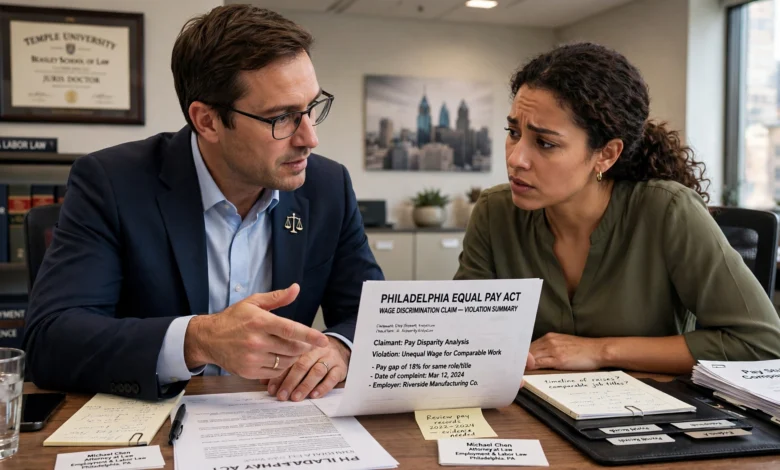
Philadelphia Equal Pay Act violations are more common than most workers realize, and they don’t always look like a boss handing a man a bigger paycheck for the same job. Sometimes it’s a hiring manager who quietly sets a lower starting salary because a candidate’s previous job paid less. Sometimes it’s a woman who finds out, almost by accident, that the guy sitting three desks away is making $15,000 more for doing the exact same work. And sometimes it’s an employee who gets written up shortly after asking a coworker what they earn.
Philadelphia has taken a more aggressive stance on pay equity than a lot of other American cities. The Philadelphia Wage Equity Ordinance, which bans employers from asking about salary history, was one of the first laws of its kind in the country, and it survived a First Amendment lawsuit from the local Chamber of Commerce before finally taking full effect in 2020. Combined with the Pennsylvania Equal Pay Law and the federal Equal Pay Act, workers in the city have more legal protection than they might assume.
Still, having a law on the books and having it enforced are two different things. The gender wage gap in Pennsylvania hasn’t closed, and Black and Hispanic women in particular continue to lose thousands of dollars a year to unequal pay. This article breaks down what counts as a violation, which laws apply, and what you can actually do about it.
What Is the Philadelphia Equal Pay Act, Exactly?
There isn’t a single statute in Philadelphia called the “Equal Pay Act.” Instead, workers in the city are protected by a layered set of rules that work together, and understanding how they overlap matters if you’re trying to figure out where your case fits.
At the local level, the Philadelphia Wage Equity Ordinance prohibits employers, employment agencies, and their agents from asking job applicants about their current or past salary, and it bars them from relying on salary history to set wages even if a candidate volunteers the information. The Philadelphia Commission on Human Relations enforces this rule and can investigate complaints, issue fines, and require back pay.
At the state level, the Pennsylvania Equal Pay Law makes it illegal to pay employees of one sex less than employees of the other sex for jobs that require substantially equal skill, effort, and responsibility, performed under similar working conditions. Pay differences are only lawful when they’re based on things like seniority, a merit system, a system that measures earnings by quantity or quality of production, or some other factor unrelated to sex.
At the federal level, the Equal Pay Act of 1963 sets a similar standard nationwide, and Title VII of the Civil Rights Act adds broader protection against pay discrimination based on sex, race, color, national origin, and religion. The Lilly Ledbetter Fair Pay Act also matters here, since it resets the clock on the filing deadline every time a discriminatory paycheck is issued, not just the first time the unequal pay decision was made.
So when people search for “Philadelphia Equal Pay Act violations,” what they’re usually asking about is a violation of one or more of these overlapping laws, whether that’s the local salary history ban, the state’s equal pay statute, or federal sex discrimination law.
How the Gender Wage Gap Actually Shows Up in Philadelphia
Talking about the gender wage gap in the abstract can make it feel like a distant policy issue. In Philadelphia, it’s a lot more concrete than that.


- Nationally, women who work full-time still earn roughly 84 cents for every dollar paid to men, and the gap is wider for many women of color.
- In Pennsylvania, Black women earn about 60 cents for every dollar earned by white, non-Hispanic men, according to Census data compiled by the National Partnership for Women and Families.
- Black Women’s Equal Pay Day, the date that marks how far into the following year Black women must work to catch up to what white men earned the prior year, falls in late July, which tells you how large that gap really is.
- Local advocates have pointed to the salary history ban specifically because it disrupts a cycle where one underpaid job follows a worker for years, since each new employer sets pay based on what the last one paid.
That last point is really the heart of why the Wage Equity Ordinance exists. If a woman’s first job out of college underpays her because of discrimination, bias, or just bad negotiating leverage, that lower number can follow her through job change after job change unless something breaks the cycle. Philadelphia’s law was designed to be that circuit breaker.
What Counts as an Equal Pay Act Violation
Not every pay difference is illegal. Employers are allowed to pay people differently based on legitimate factors like experience, education, performance, or seniority. A Philadelphia Equal Pay Act violation happens when the pay gap can’t be explained by any of those legitimate factors and instead traces back to sex, race, or another protected characteristic.
Salary History Inquiries
Under the Wage Equity Ordinance, it’s illegal for a Philadelphia employer to:
- Ask a job applicant, either on a written application or in an interview, what they currently earn or what they earned at a previous job
- Search public records or contact a previous employer specifically to find out an applicant’s salary history
- Use salary history information to determine what to offer a new hire, even if the applicant brought it up voluntarily
- Refuse to interview or hire someone because they declined to share their salary history
There’s an important exception: if an applicant discloses their salary unprompted and without any pressure, an employer isn’t automatically in violation just for having heard the number. The violation happens if the employer then uses that number to set pay.
Paying Different Wages for Substantially Similar Work
This is the classic form of wage discrimination. If a man and a woman are doing jobs that require the same skill, effort, and responsibility, under similar conditions, and one is paid less, that’s a potential violation of both the state Equal Pay Law and the federal Equal Pay Act. Job titles don’t control here. What matters is the actual content of the work.
Retaliation Against Employees Who Discuss Pay
Federal law under the National Labor Relations Act generally protects employees’ right to discuss their wages with coworkers, and Philadelphia and Pennsylvania law reinforce protections against retaliation for asserting equal pay rights. If an employer disciplines, demotes, cuts hours for, or fires someone because they compared notes on pay or filed a complaint, that retaliation is itself a separate legal violation, on top of whatever underlying pay gap prompted the conversation.
Steering Women Into Lower-Paying Roles or Tracks
Sometimes the discrimination happens before a paycheck is ever issued. Systematically funneling women into lower-paying positions, denying them the same promotion opportunities as men with comparable qualifications, or excluding them from bonus structures and overtime opportunities can all contribute to a pay gap that qualifies as unlawful discrimination, even if the base hourly rate on paper looks equal.
Federal, State, and Local Laws That Protect Philadelphia Workers
Philadelphia Wage Equity Ordinance
Signed into law in January 2017 and enforced by the Philadelphia Commission on Human Relations since September 2020, this ordinance applies to any employer with a job located within city limits, regardless of where the company is headquartered. It doesn’t apply to internal transfers or promotions with a worker’s current employer, but it does cover nearly every other hiring scenario in the city.
Pennsylvania Equal Pay Law
This state law applies statewide, not just in Philadelphia, and prohibits sex-based wage discrimination for comparable work. It allows workers to sue directly in court for back pay and, in some cases, liquidated damages equal to the amount of unpaid wages, which effectively doubles the recovery.
Federal Equal Pay Act and Title VII
The federal Equal Pay Act requires equal pay for equal work regardless of sex, and it doesn’t require proof of intentional discrimination the way some other laws do, just proof of the pay disparity itself. Title VII, enforced by the Equal Employment Opportunity Commission, covers a broader range of pay discrimination, including discrimination based on race, national origin, religion, and sex, and it does require showing that discrimination was a motivating factor.
Together, these three layers of law mean that a Philadelphia worker who’s been underpaid because of sex discrimination often has more than one legal avenue to pursue, and sometimes more than one place to file a complaint.
Signs You Might Be Dealing With Wage Discrimination
Pay discrimination is often hidden by design. Companies discourage salary talk precisely because transparency makes discrimination harder to sustain. Still, there are patterns worth paying attention to:
- A coworker doing the same job, with similar or less experience, is earning noticeably more than you
- You were asked about your salary history during the hiring process, despite the city’s ban on that question
- Men in your department get promoted faster or receive larger raises even when performance reviews look comparable
- You were offered a lower starting salary than a male colleague hired around the same time for the same role
- Your employer reacts with unusual hostility, secrecy, or discipline when pay is discussed among staff
- Bonus structures, commission splits, or overtime assignments consistently favor men on the team
None of these signs alone proves a violation, but a pattern of them is often enough to justify digging deeper, either informally by asking HR direct questions or formally by consulting an employment attorney.
How to File a Complaint or Pursue an Equal Pay Claim
Filing With the Philadelphia Commission on Human Relations
If your complaint involves salary history questions or the Wage Equity Ordinance specifically, the Philadelphia Commission on Human Relations (PCHR) is the right starting point. PCHR can investigate, mediate, and, where warranted, penalize employers who violate the ordinance. There’s typically a filing window measured in months from the date of the violation, so acting quickly matters.
Filing With the EEOC or Pennsylvania Human Relations Commission
For broader sex-based pay discrimination claims under Title VII or the state Equal Pay Law, workers can file a charge with the EEOC or the Pennsylvania Human Relations Commission. These agencies investigate the claim, and if they find reasonable cause, they may pursue the case themselves or issue a “right to sue” letter that lets the worker take the case to court independently.
Pursuing a Private Lawsuit
Under the federal Equal Pay Act, and often under the Pennsylvania Equal Pay Law, employees can go straight to court without first filing an administrative charge, which isn’t the case for most other types of employment discrimination claims. This matters because it can save time, though it also means the strategic choice of agency complaint versus direct lawsuit is worth discussing with an attorney rather than deciding alone.
A few practical steps before filing anything:
- Write down what you know about the pay gap, including dates, job titles, and any numbers you’ve learned, even informally.
- Save any emails, offer letters, or performance reviews that might show how pay decisions were made.
- Note any instance where you were asked about salary history, including who asked and when.
- Keep a record of any retaliation you experience after raising the issue.
- Talk to an employment lawyer before confronting your employer directly, since the way you raise the issue can affect your legal options later.
What Damages Can You Recover
Workers who prove a Philadelphia Equal Pay Act violation may be entitled to several types of relief, depending on which law applies and where the case is filed:
- Back pay, covering the difference between what you were paid and what you should have earned
- Liquidated damages, which under the federal Equal Pay Act can double the back pay award if the violation wasn’t made in good faith
- Front pay, in cases where reinstatement or a pay correction isn’t realistic
- Attorney’s fees and court costs, which are often recoverable under both state and federal law, making it more feasible for workers to bring claims even when the dollar amount at stake is modest
- Corrective action, requiring the employer to adjust its pay practices going forward, not just pay a settlement and move on
Why Employers Keep Violating Equal Pay Laws
If the laws are this clear, it’s fair to ask why pay discrimination keeps happening. A few reasons come up again and again:
- Pay secrecy is still the norm. Many workplaces discourage or informally punish salary conversations, which makes discrimination harder to spot from the inside.
- Legacy pay structures carry old bias forward. Even when a company stops asking about salary history, employees hired years ago under the old system often stay underpaid unless someone actively audits and corrects it.
- Enforcement resources are limited. Agencies like PCHR and the EEOC handle large caseloads, and many violations never get reported in the first place.
- Workers fear retaliation. Even with legal protections against retaliation, the fear of being labeled “difficult” or losing future opportunities keeps a lot of people quiet.
- Vague job classifications make comparisons harder. When companies blur job titles or duties, it becomes easier to argue that two employees aren’t actually doing “substantially similar” work, even when they are.
How an Employment Attorney Can Help
Wage discrimination cases often hinge on details that are hard to gather alone, like internal pay bands, historical hiring records, or patterns across an entire department rather than just one coworker’s salary. An experienced employment attorney can:
- Evaluate whether your situation actually meets the legal standard for a pay discrimination claim
- Identify which law, or combination of laws, gives you the strongest case
- Help gather evidence, including requesting pay data through discovery if the case goes to litigation
- Handle communication with your employer so you’re not navigating a hostile HR department alone
- Negotiate a settlement or take the case to trial if a fair resolution isn’t offered
- Advise you on how to protect yourself from retaliation while the claim is pending
Because attorney’s fees are often recoverable in successful equal pay cases, many employment lawyers who focus on wage discrimination take these cases on a contingency basis, meaning you don’t pay unless you win.
Steps to Take If You Suspect Pay Discrimination
- Document everything you already know. Job title, pay rate, hire date, and anything a coworker has shared with you.
- Check whether you were asked about salary history. If so, note who asked, when, and in what format, since this alone may be a violation of the Wage Equity Ordinance.
- Look for patterns, not just one data point. A single coworker’s higher salary might have a legitimate explanation. A pattern across a whole department is harder to explain away.
- Avoid confronting your employer before getting advice. How you raise the issue can affect both your legal standing and your day-to-day working relationship.
- Consult an employment attorney or file with PCHR, the EEOC, or the Pennsylvania Human Relations Commission within the applicable deadline, since waiting too long can forfeit your right to recover damages.
- Keep working normally while your claim is pending, unless your attorney advises otherwise, since performance issues can complicate a discrimination claim even when they’re unrelated to it.
- Watch for retaliation and report it immediately if it happens, since retaliation is its own violation with its own remedies.
Conclusion
Philadelphia Equal Pay Act violations rarely announce themselves. They show up as a lower starting offer, a question about past salary that should never have been asked, or a raise that somehow always lands smaller than a male colleague’s. Between the Philadelphia Wage Equity Ordinance, the Pennsylvania Equal Pay Law, and the federal Equal Pay Act and Title VII, workers in the city have real legal tools to challenge unequal pay, and those tools come with real remedies, including back pay, liquidated damages, and attorney’s fees.
Closing the gender wage gap starts with individual workers recognizing the signs, documenting what they see, and using the laws already on the books rather than assuming discrimination is just the cost of doing business.