Florida Social Security Disability Timeline: How Long Does Approval Take?
Florida Social Security Disability Timeline explained stage by stage, with real 2026 wait times for initial review, appeals, and hearings.
If you’ve filed for benefits and you’re staring at your mailbox every day, you already know the wait is the hardest part. The Florida Social Security Disability Timeline rarely moves as fast as anyone would like, and the state’s backlog has only made that more true in recent years. Whether you’re applying for Social Security Disability Insurance (SSDI) or Supplemental Security Income (SSI), understanding what happens after you submit your application can take some of the anxiety out of the process.
Florida’s Division of Disability Determinations reviews every initial claim before it ever reaches a judge, and each stage of the Florida Social Security Disability Timeline has its own pace, its own paperwork, and its own approval odds. Some claimants get a decision in a matter of months. Others, especially those who need to appeal, wait well over a year before they see a resolution.
This article walks through every stage of the process, from the day you file to the day your first payment lands, using current 2026 data on Florida wait times. You’ll also find practical steps you can take to avoid unnecessary delays, along with an honest look at why so many initial applications get denied in the first place. If you’re trying to plan your finances around an uncertain timeline, this guide should give you a realistic picture of what to expect.
Understanding the Florida Social Security Disability Timeline
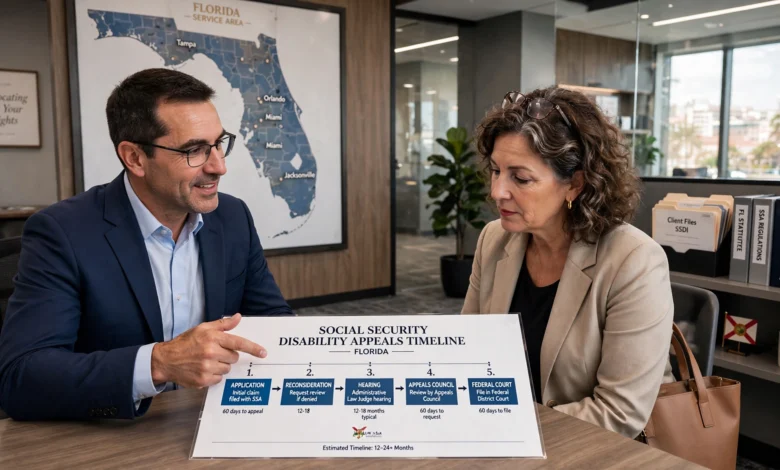
The Florida Social Security Disability Timeline isn’t a single countdown clock. It’s a series of separate stages, and your claim only moves to the next one if the previous one doesn’t end in approval. Each stage is handled by a different part of the system, which is a big reason the whole process can feel disjointed.
At a high level, a Florida disability claim moves through these phases:
- Initial application and review by the Division of Disability Determinations
- Initial decision (approval or denial)
- Reconsideration appeal, if the initial claim is denied
- Administrative Law Judge (ALJ) hearing, if reconsideration is also denied
- Appeals Council review, in rare cases
- Federal court review, in even rarer cases
- Payment processing after a final approval
Most Florida claimants never make it past the hearing stage, either because they’re approved earlier or because they stop pursuing the claim after a second denial. Knowing where you are in this sequence helps you set realistic expectations and plan around the wait.
Stage 1: Filing Your Initial Application
The clock on your Florida Social Security Disability Timeline starts the moment the Social Security Administration (SSA) receives your application, whether you file online, by phone, or in person at a local field office. This first stage is mostly administrative. SSA checks that you meet the basic, non-medical requirements, such as work credits for SSDI or income and asset limits for SSI.
Once the paperwork clears the field office, your file is sent to Florida’s Division of Disability Determinations (DDD), the state agency responsible for making the actual medical decision on your claim. This handoff typically happens within a few weeks, though it can take longer if your application is incomplete or if SSA needs to verify additional information.
A few things that speed this stage along:


- Submitting a complete application with accurate work history
- Providing contact information for every doctor, clinic, and hospital you’ve seen
- Responding quickly to any follow-up requests from your local field office
Missing or incomplete records at this stage are one of the most common reasons a claim stalls before it even reaches a medical examiner.
Stage 2: Initial Review and Decision
This is usually the longest single stretch of the Florida Social Security Disability Timeline for claimants who are approved early. Florida’s DDD assigns your case to a disability examiner, who works with a medical consultant to review your records against SSA’s five-step sequential evaluation process. That process looks at whether you’re working, how severe your condition is, whether it meets or equals a listed impairment, whether you can do your past work, and whether you can adjust to other work.
As of 2026, the average initial decision in Florida takes roughly six to eight months, though some sources put the statewide average closer to seven months when accounting for recent processing improvements. A straightforward claim with strong, consistent medical documentation can move faster. A claim that requires a consultative examination, meaning SSA sends you to an independent doctor for evaluation, will almost always take longer.
Unfortunately, the numbers at this stage are tough. Roughly 65% of initial applications in Florida are denied, which is in line with the national trend. Denial doesn’t mean your condition isn’t real or serious. It often reflects gaps in medical evidence, inconsistent treatment history, or claims that don’t clearly connect the medical diagnosis to an inability to work.
What Slows Down the Initial Review
Several factors can add weeks or months to this stage:
- Missing or delayed medical records from providers
- The need for a consultative examination
- Complex work histories, such as self-employment or multiple part-time jobs
- Conditions that require specialist input, like mental health or chronic pain claims
- A backlog at the specific DDD office handling your file
If you haven’t heard anything after four or five months, it’s reasonable to call SSA or your representative for a status update rather than assume the worst.
Stage 3: Reconsideration Appeal
If your initial application is denied, the next step in the Florida Social Security Disability Timeline is reconsideration. You have 60 days from the date on your denial letter to request this appeal, and missing that deadline generally means starting the entire process over.
Reconsideration is a full review of your file by a different examiner and medical consultant who weren’t involved in the first decision. In theory, it’s a fresh look. In practice, the approval rate here is low, hovering around 10% to 15% in Florida. This stage typically adds another three to five months to your timeline.
Because so few claims succeed at reconsideration, this is often the point where claimants start looking into legal representation, particularly if new medical evidence has become available since the initial denial. Updating your file with recent test results, new diagnoses, or a more detailed statement from your treating physician can genuinely change the outcome.
Stage 4: The Administrative Law Judge Hearing
For most people who get approved after an initial denial, it happens here. The ALJ hearing is the stage where you or your representative present your case directly to a judge, and it carries by far the best odds in the entire Florida Social Security Disability Timeline, with roughly 61% of hearing-level cases approved statewide.
It’s also, by a wide margin, the slowest stage. Florida hearing offices are dealing with heavy caseloads, and wait times from the date you request a hearing to the date you actually appear before a judge commonly run nine to eighteen months, depending on which office handles your case. Central and South Florida offices, including Orlando and the Fort Lauderdale area, tend to run on the longer end of that range because of population size and case volume. Smaller offices, such as Fort Myers, have sometimes processed hearings somewhat faster.
After the hearing itself, expect another two to three months before you receive the judge’s written decision. All told, the hearing stage alone can take a year or more from start to finish, which is why claimants who reach this point are often advised to keep their medical treatment current and their documentation organized while they wait.
How to Prepare While You Wait for a Hearing
- Keep every scheduled appointment with your treating physicians
- Save copies of imaging results, lab work, and specialist notes as they come in
- Make sure your file reflects how your condition limits sitting, standing, lifting, concentration, and attendance, not just your diagnosis
- Submit new evidence well before SSA’s deadline, generally at least five business days before the hearing
- Consider working with a representative who can identify weak spots in your file before the judge does
Stage 5: Appeals Council and Federal Court
Very few Florida claims reach this far, but it’s worth knowing it exists. If the ALJ denies your claim, you can request a review by the SSA Appeals Council. This step can take anywhere from several months to well over a year, and the council can deny review, send the case back to a judge, or in rare instances reverse the decision outright.
If the Appeals Council denies your request or upholds the denial, your final option is to file a civil action in federal district court. This is a legal proceeding, not an administrative one, and it typically requires an attorney. Timelines here vary widely and can extend a year or more beyond the Appeals Council stage.
Because approval rates drop sharply the further a claim goes, most disability attorneys focus their efforts on building the strongest possible case before or during the ALJ hearing, since that’s genuinely the best opportunity most claimants get.
Stage 6: What Happens After Approval
Getting approved is a relief, but it isn’t the final step in the Florida Social Security Disability Timeline. SSDI includes a mandatory five-month waiting period from your established disability onset date before benefits begin, which is separate from how long your claim took to process. If your onset date is far enough in the past, that waiting period may already be satisfied by the time you’re approved.
Once SSA finalizes your award, most Florida recipients see their first monthly payment within 30 to 60 days. Back pay, which covers the period between your application date (or onset date, whichever applies) and your approval, often arrives around the same time, though SSA has noted it can take three to five months in more complicated cases involving representative fees or overpayment issues.
A few things worth knowing about this final stretch:
- Approval and payment are processed by different parts of SSA, so a gap between the two is normal
- Representative fees, when applicable, are deducted from back pay before it’s released to you
- SSI recipients may see payments arrive faster than back pay for SSDI, since SSI doesn’t have the same waiting period
Why the Florida Timeline Varies So Much
No two claims move through the Florida Social Security Disability Timeline at the same pace, and a few factors explain most of the variation:
- Medical complexity – Conditions that require multiple specialists or extensive testing take longer to document and review.
- Completeness of records – Claims with clear, consistent treatment histories move faster than those with gaps or inconsistent providers.
- Office workload – Some DDD offices and hearing offices carry heavier caseloads than others, which directly affects wait times.
- Consultative examinations – Any time SSA has to schedule an outside medical exam, add weeks to months to the timeline.
- Representation – Claimants with organized files and experienced representatives often avoid delays caused by missing evidence or procedural errors.
Understanding these factors won’t necessarily speed up your specific claim, but it can help explain why your neighbor’s approval took four months while yours has stretched past a year.
Tips to Avoid Unnecessary Delays
While you can’t control SSA’s backlog, there are steps that genuinely help keep your claim moving:
- Respond to every SSA request as quickly as possible, even if it feels repetitive
- Keep your contact information current so you don’t miss important notices
- Attend every scheduled medical appointment and consultative exam
- Follow your treating physician’s recommended care plan consistently
- Track deadlines closely, especially the 60-day windows for reconsideration and hearing requests
- Consider legal representation if your claim involves multiple conditions, a disputed onset date, or a prior denial
For official processing data and current SSA performance figures, the Social Security Administration’s disability programs page and the agency’s hearings and appeals processing reports are the most reliable sources for up-to-date national and regional figures.
Frequently Asked Questions
How long does the Florida Social Security Disability Timeline usually take from start to finish? For claimants approved at the initial stage, six to eight months is typical. For those who need to appeal all the way to a hearing, the total process often runs one and a half to two years.
Can I speed up my Florida disability claim? You can’t force SSA to move faster, but you can avoid self-inflicted delays by submitting complete records, responding quickly to requests, and keeping consistent medical treatment.
Does hiring a lawyer shorten the Florida Social Security Disability Timeline? Not directly, but representation often improves the quality of your file, which can reduce the chance of a denial that would otherwise add months or years through the appeals process.
What’s the difference between the SSDI waiting period and the processing timeline? The processing timeline is how long SSA takes to review and decide your claim. The five-month SSDI waiting period is a separate rule tied to your disability onset date and applies even after approval.
Conclusion
The Florida Social Security Disability Timeline is rarely quick, and it’s almost never predictable down to the month. Initial decisions generally take six to eight months, reconsideration appeals add several more, and a hearing before an administrative law judge, where approval odds are highest, can stretch the total process well past a year. Payment typically follows within 30 to 60 days of a final approval, separate from the mandatory five-month SSDI waiting period.
While you can’t control SSA’s backlog or your local office’s caseload, staying on top of deadlines, keeping your medical records current, and responding promptly to every request can help make sure your claim isn’t delayed for reasons within your control. Knowing what to expect at each stage won’t make the wait shorter, but it can make it a lot less confusing.