Florida Wage Theft: How to Recover Unpaid Overtime and Commissions
Owed unpaid overtime or commissions in Florida? Learn how Florida wage theft claims work, what you can recover, and the steps to get paid.
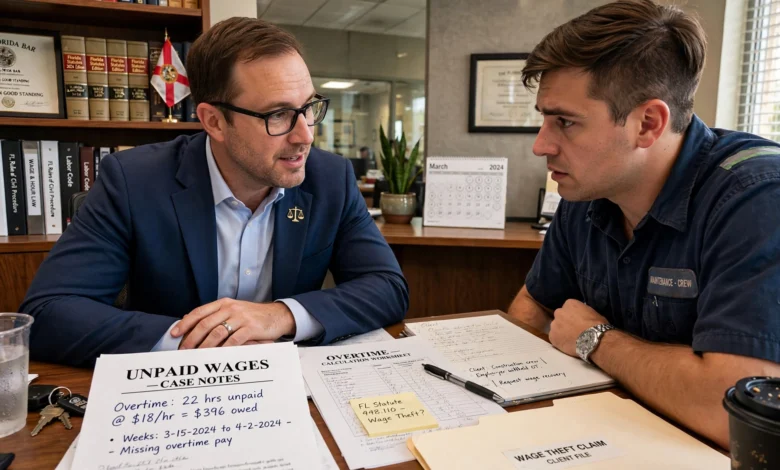
Florida wage theft is more common than most workers realize, and it’s not always obvious when it’s happening to you. Maybe your paycheck looks a little short every week and you’ve chalked it up to taxes. Maybe your manager keeps telling you overtime “doesn’t apply” to your role. Maybe you closed a big sale months ago and the commission check never showed up. These aren’t small clerical mistakes. In many cases, they’re violations of federal and Florida wage law, and you have real options for getting that money back.
This guide walks through what counts as wage theft in Florida, how unpaid overtime claims work under the Fair Labor Standards Act, what to do when an employer withholds earned commissions, and the specific steps you can take right now to start recovering what you’re owed. We’ll also cover deadlines, damages you can claim, and when it makes sense to bring in an employment attorney.
Florida workers lose a meaningful chunk of income every year to wage violations, and low-wage and hourly employees are hit hardest. The good news is that the law gives you tools to fight back, including the ability to recover double damages and, in some cases, get your attorney’s fees paid by the employer who shorted you. Let’s break down exactly how that process works.
What Counts as Wage Theft in Florida
Wage theft is a broad term, but at its core it means an employer failed to pay a worker money they legally earned. It doesn’t require a dramatic scheme. Most cases involve pay practices that quietly chip away at a paycheck, often practices workers don’t even recognize as illegal.
Common forms of wage theft in Florida include:
- Paying less than minimum wage (Florida’s minimum wage is higher than the federal rate and adjusts each year)
- Refusing to pay overtime to employees who work more than 40 hours in a week
- Requiring employees to work “off the clock” before or after their shift
- Automatically deducting for meal breaks the employee didn’t actually get to take
- Misclassifying employees as independent contractors to avoid paying benefits and overtime
- Misclassifying hourly workers as “exempt” salaried employees
- Withholding earned commissions or bonuses that were promised under a pay plan or contract
- Failing to pay a final paycheck after termination or resignation
- Illegally deducting money from paychecks for shortages, damages, or uniforms
None of these are minor administrative issues. Each one can form the basis of a legal claim, and in many cases, the employee is entitled to far more than just the missing wages.
Why Wage Theft Happens So Often
A lot of wage theft isn’t malicious in the dramatic sense. It’s often the result of an employer trying to save on labor costs by misclassifying workers, assuming a salaried title automatically means “no overtime,” or simply hoping employees won’t push back. Confusing pay stubs, vague commission agreements, and constantly shifting job duties all make it harder for workers to notice when something’s off, which is exactly why employers get away with it for so long.
Unpaid Overtime: What the Law Actually Requires
Florida does not have its own separate overtime law. Instead, overtime protections for Florida workers come from the federal Fair Labor Standards Act (FLSA). Under the FLSA, non-exempt employees must be paid one and a half times their regular rate of pay for every hour worked beyond 40 in a single workweek. You can read the federal rules directly from the U.S. Department of Labor’s <a href=”https://www.dol.gov/agencies/whd/overtime” target=”_blank” rel=”noopener”>overtime pay guidance</a> for the current thresholds and exemption tests.
Who Is Entitled to Overtime Pay
Not every employee qualifies for overtime. The FLSA divides workers into two broad categories:


- Non-exempt employees — Generally hourly workers, who are entitled to overtime pay whenever they work more than 40 hours in a workweek.
- Exempt employees — Certain salaried workers in specific categories who are not entitled to overtime, provided they meet strict duties and salary tests.
The most commonly claimed exemptions are the “white-collar” exemptions, covering executive, administrative, and professional employees, along with the outside sales exemption. But here’s the catch: job title alone doesn’t determine exemption status. An employer can call you a “manager” or put “coordinator” in your email signature, and it means nothing if your actual day-to-day duties don’t meet the legal test. This is one of the most frequent forms of overtime misclassification, and it’s a major driver of wage theft claims in Florida.
Common Overtime Violations
- Classifying an employee as exempt without meeting the salary or duties requirements
- Averaging hours across two workweeks instead of paying overtime for each individual week over 40 hours
- Paying a flat salary regardless of hours worked, assuming it covers unlimited overtime
- Failing to count mandatory training, travel between job sites, or “on-call” time as compensable hours
- Editing timesheets to shave off hours worked
- Paying “straight time” for overtime hours instead of time-and-a-half
If any of these sound familiar, you may have a legitimate unpaid overtime claim, even if your employer insists otherwise.
Unpaid Commissions: A Different Kind of Wage Theft
Commission disputes work a little differently than overtime disputes, and that difference matters. Federal wage law doesn’t require employers to pay commissions at all. Instead, whether you’re owed a commission usually comes down to the terms of your commission agreement, offer letter, or employment contract. If your employer promised you a percentage of a sale, a bonus structure tied to performance, or a draw against future commissions, and you met the conditions, that money is legally yours, even if the employer later tries to change the rules retroactively.
When Commission Withholding Becomes Wage Theft
Employers sometimes try to avoid paying commissions using a few common tactics:
- Changing the commission plan after the employee already closed the deal
- Terminating an employee shortly before a commission is scheduled to vest or pay out
- Claiming a sale “doesn’t count” using vague or shifting criteria not in the original agreement
- Refusing to pay commissions earned before an employee resigned or was let go
- Delaying payment indefinitely with no clear payment schedule
Courts generally look at what the commission agreement said at the time the work was performed, not what the employer decided to change it to afterward. If you did what the agreement required, whether that’s closing a sale, hitting a quota, or completing a project, the commission was earned, and Florida law generally treats earned wages as property the employer cannot simply take back.
Documenting a Commission Claim
Because commission disputes often hinge on interpreting an agreement, documentation matters even more here than in overtime cases. Before you take any other steps, try to gather:
- Your written commission plan or agreement, including any amendments
- Offer letters or emails referencing commission terms
- Sales records, CRM entries, or invoices showing the deals you closed
- Pay stubs showing past commission payments (to establish a pattern of how the plan was applied)
- Any communication where a manager acknowledged the commission was owed
The more paper trail you have showing what was promised and what you delivered, the stronger your claim becomes.
What You Can Recover in a Florida Wage Theft Claim
This is where Florida and federal law start working in your favor. If you win a wage theft or unpaid overtime claim, you’re not just entitled to the wages you were originally owed. Depending on the law you bring your claim under, you may be able to recover:
- Back pay — the actual unpaid wages, overtime, or commissions owed
- Liquidated damages — under the FLSA and Florida Minimum Wage Act, this is an additional amount equal to the unpaid wages, effectively doubling your recovery
- Treble damages — some Florida county wage theft ordinances (including those in Miami-Dade, Hillsborough, and Pinellas counties) allow victims to recover up to three times the amount owed
- Interest on the unpaid amount
- Attorney’s fees and court costs — both the FLSA and Florida Minimum Wage Act require the employer to pay the employee’s reasonable attorney’s fees if the employee wins
That attorney’s fee provision is a big deal. It means most employment attorneys who handle wage theft cases work on contingency, so you generally don’t need to pay anything upfront to pursue a claim.
How Much Is Your Claim Actually Worth?
The value of a wage theft claim depends on a few factors:
- How many weeks or months of unpaid wages, overtime, or commissions are involved
- Your regular rate of pay (which determines your overtime rate)
- Whether liquidated or treble damages apply
- Whether the violation was willful (which can extend how far back you can claim)
Even a few months of missed overtime can add up quickly once liquidated damages are factored in, which is why it’s worth calculating your potential recovery before deciding whether to pursue a claim.
Step-by-Step: How to Recover Unpaid Overtime and Commissions in Florida
If you believe you’re owed wages, here’s a practical roadmap for moving forward.
Step 1: Gather Your Records
Before you contact anyone, start collecting documentation. This includes:
- Pay stubs and W-2s or 1099s
- Time records, schedules, or clock-in/clock-out data
- Emails or texts discussing your hours, pay rate, or commission terms
- Your employee handbook or written pay policies
- Any commission agreements or bonus plans
If your employer didn’t keep accurate records (which happens more than you’d think), your own notes about the hours you worked can still be used as evidence.
Step 2: Calculate What You’re Owed
Work out your regular hourly rate, then calculate the overtime premium for any hours over 40 in a workweek. For commissions, compare what the agreement promised against what you actually deployed in sales or performance and what you were actually paid.
Step 3: Send a Written Demand
A written notice to your employer explaining what you believe you’re owed can sometimes resolve the issue without a lawsuit. It also creates a paper trail showing the employer was on notice, which matters for calculating damages and, in some jurisdictions, is a required step before filing certain claims.
Step 4: Choose the Right Filing Path
Depending on the size and complexity of your claim, you have a few options:
- File a complaint with the U.S. Department of Labor’s Wage and Hour Division. The federal government can investigate FLSA violations and, in some cases, recover wages on your behalf at no cost to you.
- File in Florida small claims court for amounts up to $8,000, or in county or circuit court for larger claims.
- File under a local wage theft ordinance if your county has one, such as Miami-Dade, Hillsborough, Broward, or Pinellas counties, which often allow for faster administrative resolution and enhanced damages.
- Hire an employment attorney to file a lawsuit directly, especially if liquidated damages, treble damages, or a class of similarly affected coworkers are involved.
Step 5: Meet the Deadlines
Wage claims aren’t open-ended. Under the FLSA, you generally have two years from the date of the violation to file a claim, or three years if the violation was willful. Waiting too long can mean losing your right to recover months or even years of unpaid wages, so don’t sit on a claim once you realize something is wrong.
Retaliation: Know Your Protections
One of the biggest reasons workers hesitate to report wage theft is fear of losing their job. Federal and Florida law explicitly prohibit employers from retaliating against employees who assert their wage rights, whether that’s filing a complaint, asking questions about pay, or cooperating with an investigation. Retaliation can include firing, demoting, cutting hours, or otherwise punishing a worker for raising a legitimate wage concern. If retaliation happens after you raise a wage issue, that itself can become a separate legal claim, often with its own set of damages.
Independent Contractor Misclassification and Wage Theft
A large share of wage theft cases in Florida stem from misclassification, where a worker who should legally be treated as an employee is instead labeled an independent contractor. This label matters because independent contractors aren’t covered by minimum wage or overtime protections. Employers sometimes lean on this classification specifically to avoid paying overtime, benefits, or payroll taxes.
Courts don’t just look at what your contract calls you. They look at the actual working relationship, including:
- How much control the employer has over your schedule and how you do your job
- Whether you use your own tools and equipment or the employer’s
- Whether the work you do is central to the employer’s business
- Whether you can work for other companies at the same time
- How you’re paid and whether you bear any real financial risk
If your working relationship looks more like an employee’s than a true independent contractor’s, you may be entitled to overtime and other protections regardless of what your paperwork says.
Should You Hire a Florida Employment Attorney?
Not every wage dispute needs a lawyer, but many benefit from one, especially when overtime misclassification, commission agreements, or larger dollar amounts are involved. Because both the FLSA and the Florida Minimum Wage Act require employers to pay the employee’s attorney’s fees if the case succeeds, most employment lawyers in this area take cases on contingency, meaning you pay nothing out of pocket unless you win.
An attorney can help you:
- Calculate the full value of your claim, including liquidated or treble damages
- Determine whether federal law, Florida law, or a county ordinance gives you the strongest path
- Draft a demand letter that puts real pressure on the employer to settle
- File a lawsuit and represent you through negotiation or trial
- Protect you from retaliation while your claim moves forward
If you’re unsure whether your situation qualifies, a consultation costs you nothing to find out, and it’s worth doing sooner rather than later given the filing deadlines involved.
Frequently Overlooked Situations That Still Count as Wage Theft
A few scenarios workers often don’t recognize as wage theft, but should:
- Being asked to arrive early or stay late “off the clock” — this time is generally compensable even if you’re not clocked in.
- Salary employees working well beyond 40 hours — a salary doesn’t automatically mean you’re exempt from overtime.
- Commission “chargebacks” after termination — clawing back already-earned commissions after you leave a job is often improper if the commission was fully earned under the agreement.
- Tipped employees not receiving enough to reach minimum wage — employers must make up the difference if tips don’t bring a worker’s pay up to Florida’s minimum wage.
- Unpaid final paychecks — Florida law doesn’t set a specific deadline for final paychecks in every case, but unreasonably withholding a final check can still support a wage claim.
If any of this sounds like your situation, it’s worth a closer look rather than assuming it’s just “how the job works.”
Practical Tips While You Build Your Case
- Keep your own time log. Don’t rely solely on employer records, especially if you suspect they’ve been altered.
- Save everything in writing. Screenshot text messages and forward emails to a personal account if you’re worried about losing access after leaving the job.
- Don’t sign anything under pressure. Some employers offer a quick settlement or severance agreement that waives wage claims. Have it reviewed before signing.
- Talk to coworkers carefully. If others are experiencing the same pay issues, that can strengthen a collective or class claim, but be mindful of confidentiality and retaliation risks.
- Act before the deadline. The two- or three-year window under the FLSA moves fast once you consider how long some violations go unnoticed.
For a fuller breakdown of the federal wage and hour rules that apply in every state, including Florida, the Department of Labor’s <a href=”https://www.dol.gov/agencies/whd” target=”_blank” rel=”noopener”>Wage and Hour Division</a> publishes fact sheets on overtime exemptions, recordkeeping requirements, and how to file a complaint.
Conclusion
Wage theft in Florida takes many forms, from denied overtime and misclassified job titles to commissions promised and never paid, and it costs workers real money every year. The law is built to correct this, offering not just repayment of what’s owed but liquidated damages, potential treble damages under local ordinances, interest, and attorney’s fees that shift the financial burden back onto the employer.
If your paycheck or commission structure doesn’t add up, start by documenting everything, calculate what you believe you’re owed, and don’t let the clock run out on your right to file a claim. Whether you pursue a Department of Labor complaint, a county wage theft ordinance, or a lawsuit with the help of an employment attorney, the path to recovering unpaid overtime and commissions is more accessible than most workers realize, and it starts with simply taking the first step.