UK Human Rights Act: London Solicitors for Government Violations
UK Human Rights Act guide: how London solicitors challenge unlawful government actions, strict time limits, compensation, legal aid and next steps.
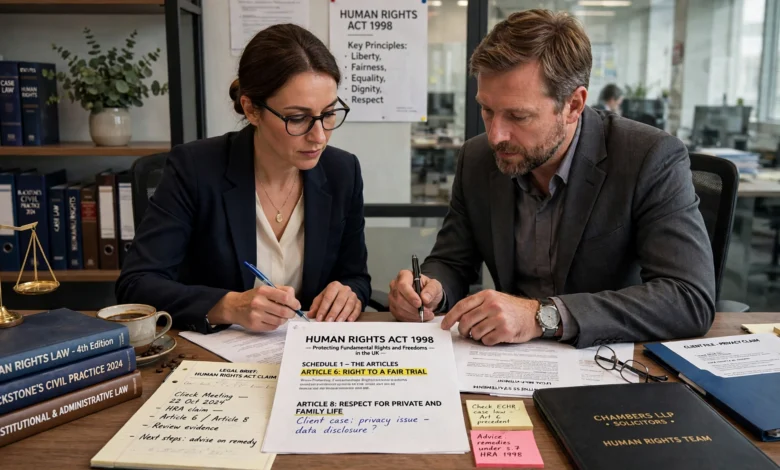
The UK Human Rights Act is one of the few laws that lets an ordinary person take the state to court and win. If the police, the Home Office, your local council, an NHS trust or a prison has treated you in a way that crosses a legal line, this Act gives you a route to challenge it in a British court rather than waiting years for a hearing in Strasbourg.
The trouble is that most people only learn how it works after something has gone wrong. By then, they are often stressed, short on time and unsure whether what happened to them counts as a breach at all. Some assume human rights law is only for high-profile cases. Others miss a deadline because nobody told them it existed.
This guide is written for anyone in London who believes a public body has violated their rights. It explains what the Human Rights Act 1998 actually covers, which government bodies can be held responsible, the most common types of violations that human rights solicitors in London deal with, and the seven main legal routes they use to challenge them.
You will also find practical detail on time limits, compensation, legal aid and how to choose the right lawyer. The aim is simple: to help you understand where you stand before you pick up the phone, so you can have a clearer, more useful first conversation with a solicitor and make better decisions about your case.
What the UK Human Rights Act Actually Does
The UK Human Rights Act came into force in October 2000. Its main job is to bring the rights in the European Convention on Human Rights (ECHR) into domestic law, so people can enforce them in courts in England, Wales, Scotland and Northern Ireland. You can read the full text on the official Human Rights Act 1998 page at legislation.gov.uk.
Three sections do most of the heavy lifting:
- Section 6 makes it unlawful for a public authority to act in a way that is incompatible with a Convention right, unless primary legislation leaves it no choice.
- Section 7 allows a person who is a “victim” of that unlawful act to bring proceedings or rely on their rights in existing proceedings.
- Section 8 lets a court grant any remedy within its powers that it considers just and appropriate, including human rights compensation in some cases.
There are also important sections about legislation itself. Section 3 requires courts to read laws in a way that fits with Convention rights wherever possible. Section 4 allows higher courts to issue a declaration of incompatibility where that is not possible. These matter more in bigger strategic cases, but they shape everyday outcomes too.
The Convention Rights That Come Up Most Often
Not every right appears in practice with the same frequency. In London, the articles that come up most in government violation claims include:
- Article 2, right to life. Deaths in custody, deaths in mental health care, and failures by the state to protect someone from a known and real risk.
- Article 3, freedom from torture and inhuman or degrading treatment. Serious mistreatment in custody, detention conditions, and in some cases police failures to properly investigate serious violence.
- Article 5, right to liberty. Unlawful arrest, unlawful immigration detention, and people being held without proper legal authority.
- Article 6, right to a fair trial. Procedural unfairness in decisions that affect civil rights.
- Article 8, right to respect for private and family life. Data misuse, surveillance, social care decisions, child removals, housing and immigration cases.
- Articles 10 and 11, freedom of expression and assembly. Protest policing and restrictions on speech.
- Article 14, protection from discrimination. This works alongside other rights rather than on its own.
Who Counts as a Public Authority
This is where many people get stuck. The UK Human Rights Act only applies to public authorities, not to private individuals or ordinary businesses acting privately.


Obvious public authorities include government departments like the Home Office, the Metropolitan Police and other police forces, London borough councils, NHS trusts, courts and tribunals, and the prison and probation services.
The line gets less clear with private organisations that carry out public functions, such as some private prison operators, immigration removal centre contractors and certain care providers. Whether they count depends on the nature of the function they are performing. This is exactly the kind of question a specialist public law solicitor will look at early, because it decides whether an HRA claim is even possible.
Common Government Violations London Solicitors Handle
Most human rights claims against public authorities in London fall into a handful of familiar categories. Knowing them can help you recognise whether your situation fits.
Police Misconduct and Failures
Claims against the Met, the City of London Police and British Transport Police are a large share of the work. They include wrongful arrest, excessive force, unlawful stop and search, strip searches carried out without proper justification, and heavy-handed policing of protests.
There is also a less obvious category: failures to investigate. In the 2018 Supreme Court case brought by victims of John Worboys (Commissioner of Police of the Metropolis v DSD), the court confirmed that serious failures in investigating grave crimes can breach Article 3. That ruling still shapes how solicitors approach cases where the police did not take a serious report seriously.
Home Office and Immigration Detention
Immigration work generates a steady stream of Article 5 and Article 8 cases. Common problems include people held in immigration detention for longer than the law allows, detention of vulnerable people who should not have been held at all, and removal decisions that fail to properly weigh family life in the UK.
Local Councils and Social Care
London boroughs make decisions every day that touch family life, disability support and housing. Solicitors regularly see challenges over care assessments, support for care leavers, children being taken into care without fair process, and housing decisions affecting disabled residents.
NHS and Mental Health Services
When someone dies or is seriously harmed while under the care of a mental health trust, Article 2 can apply. The Supreme Court’s decision in Rabone v Pennine Care (2012) confirmed that the state’s duty to protect life can extend to voluntary psychiatric patients, not only those detained under the Mental Health Act.
Prisons and Custody
Claims here often involve unsafe conditions, failures to protect prisoners from self-harm or violence, use of segregation, and inadequate healthcare behind bars.
7 Ways London Solicitors Challenge Violations Under the UK Human Rights Act
There is no single “human rights case.” Depending on what happened and what you want to achieve, human rights solicitors in London will usually pick from the following routes, and sometimes combine several.
1. A Pre-Action Letter
Almost every challenge starts with a formal letter to the public body. For judicial review, this follows the Pre-Action Protocol, and the authority is usually expected to reply within 14 days.
A well-drafted letter sets out the facts, the rights engaged, why the decision or conduct is unlawful, and what you want done. A surprising number of cases end here. Councils and government departments often back down when faced with a clear, credible legal argument, especially when the costs of losing in court are real.
2. Judicial Review
Judicial review is the main tool for stopping or overturning an unlawful decision. It is heard in the Administrative Court, which sits at the Royal Courts of Justice in London.
It is not about whether the decision was wise. It asks whether it was lawful, rational and fair, and whether it complied with Convention rights. Judicial review is ideal when you need something to change quickly, such as a detention to end, a care package to be restored or a removal to be paused.
3. A Damages Claim Under Section 7
If the harm has already happened and you want recognition and compensation, a solicitor can bring a standalone claim under section 7 of the UK Human Rights Act. These are often run alongside other civil claims, such as false imprisonment, assault, negligence or misfeasance in public office.
Pairing claims matters. The HRA has a short time limit (more on that below), while some traditional civil claims give you longer. An experienced solicitor will plead both where the facts allow.
4. Using Your Rights as a Defence
You do not always have to be the one starting the fight. If a public body brings proceedings against you, such as a council seeking possession of your home, you can rely on your Convention rights as part of your defence. Article 8 arguments in housing possession cases are a common example.
5. Article 2 Inquests
When someone dies in state custody or care, or where the state may have failed to protect them from a known risk, the inquest can become an Article 2 inquest. These are broader than standard inquests and look at the wider circumstances of the death, not just the immediate cause.
Families are often represented by specialist solicitors at these hearings. The findings can later support a civil claim and push institutions to change their practices.
6. Declarations of Incompatibility
Sometimes the problem is not the official who made the decision but the law itself. If legislation cannot be read compatibly with Convention rights, the High Court or above can issue a declaration of incompatibility under section 4.
This does not strike the law down or award compensation. Parliament stays in charge of whether to change it. But these declarations carry real political weight and have led to amendments in the past, which is why they tend to feature in strategic cases brought by larger London firms and campaigning organisations.
7. An Application to the European Court of Human Rights
If domestic routes are exhausted and you still believe your rights were breached, you can apply to the European Court of Human Rights in Strasbourg. Since February 2022, the deadline is four months from the final domestic decision.
Very few cases get this far, and most applications are declared inadmissible. It is a last resort rather than a strategy, but it remains an important backstop.
UK Human Rights Act Time Limits You Cannot Afford to Miss
Time limits are where good cases are lost. The rules are strict and courts do not bend them easily.
- HRA damages claims: one year from the date of the act complained of, under section 7(5). The court can extend this if it considers it fair, but you should never rely on that.
- Judicial review: the claim must be brought promptly and in any event within three months of the grounds arising. Some areas, such as certain planning decisions, have even shorter limits.
- Related civil claims: claims such as false imprisonment usually have a six year limit, while personal injury claims usually have three years. These can sometimes rescue a case where the HRA deadline has passed.
- Strasbourg: four months from the final domestic decision.
The practical lesson is to speak to a solicitor as early as you can, even if you are not sure you want to take action. Getting advice is not the same as committing to a claim.
What Human Rights Compensation Looks Like in Practice
People often expect large payouts. The reality under the UK Human Rights Act is more modest, and it helps to know that going in.
Under section 8, damages are only awarded where the court decides they are necessary to give “just satisfaction.” UK courts look at what the European Court of Human Rights would award, and those sums tend to be lower than typical personal injury damages. In some cases, the court decides that a formal finding that your rights were breached is enough on its own.
That said, compensation can still be meaningful, and it often comes through the related civil claims rather than the HRA alone. For example, damages for unlawful immigration detention or wrongful arrest can be substantial when calculated under the law of false imprisonment.
For many clients, money is not the main goal anyway. What they want is:
- An acknowledgement that what happened was wrong
- An apology
- A change in policy so it does not happen to someone else
- The decision reversed, or the harm stopped
A good human rights lawyer in London will ask what outcome matters most to you and build the case around that.
Funding a Claim Against the Government
Cost is the biggest worry for most people. Fortunately, there are several options.
Legal Aid
Legal aid for human rights claims is still available in England and Wales for judicial review and for certain damages claims against public authorities, particularly those involving abuse of power or significant breaches of Convention rights. Eligibility depends on your finances and the strength of the case. You can do an initial check on the government’s legal aid eligibility checker. For some inquests, families can apply for exceptional case funding.
Conditional Fee Agreements
Some firms take damages claims on a no win, no fee basis, typically where the prospects are strong and compensation is likely. Ask exactly what percentage they would take from your damages and whether you need insurance against paying the other side’s costs.
Cost Protection and Crowdfunding
In judicial review cases with a wider public interest, a costs capping order can limit your exposure to the government’s legal costs. Crowdfunding has also become a common way to pay for public interest challenges, especially where legal aid is not available.
Private Funding
If none of the above fits, a solicitor may offer fixed fees for specific stages, such as an initial advice meeting or a pre-action letter. This lets you test the waters without committing to the full cost of litigation.
How to Choose the Right Human Rights Solicitor in London
London has more specialist public law solicitors than anywhere else in the UK, which is a real advantage. It also means you need a way to tell them apart.
Here is what to look for:
- Genuine specialism. Human rights and public law should be a core practice area, not something listed at the bottom of a general services page.
- Relevant experience. Someone brilliant at immigration detention may not be the right person for a death in custody. Ask about cases similar to yours.
- A legal aid contract. If you may qualify, make sure the firm actually holds a public law or actions against the police contract with the Legal Aid Agency.
- Regulation. Check they are on the Law Society’s Find a Solicitor directory and regulated by the Solicitors Regulation Authority.
- Independent rankings. Directories like Chambers and Partners and The Legal 500 rank civil liberties and human rights teams in London. They are not perfect, but they are a useful starting point.
- Straight talking. A good solicitor will tell you plainly if your case is weak. Be wary of anyone who promises a result on the first call.
If you are not ready for a solicitor yet, the Citizens Advice guidance on taking legal action about human rights is a clear, free place to start.
What to Expect When You Bring a Human Rights Claim
Every case is different, but the path usually looks something like this:
- Initial consultation. You explain what happened. The solicitor identifies the public body involved, the rights engaged and the deadlines in play.
- Evidence gathering. This often means data subject access requests for records held about you, such as police logs, custody records, medical notes or Home Office files.
- Funding sorted. Legal aid application, CFA or private arrangement.
- Pre-action letter. The public body is formally told what it did wrong and given a chance to respond.
- Negotiation or proceedings. Many cases settle at this stage. If not, a claim is issued in the High Court, the County Court or the Administrative Court depending on the route.
- Outcome. This could be a quashed decision, a settlement, compensation, a declaration, or a combination.
Keep a written timeline from the start. Dates, names, what was said and any documents you received can make a real difference to how quickly a solicitor can assess your case.
Is the UK Human Rights Act Changing?
The future of the UK Human Rights Act is a live political question, so it is worth knowing where things stand.
A previous government’s plan to replace the Act with a Bill of Rights was dropped in 2023, and the Human Rights Act 1998 remains fully in force. Debate has continued since, much of it focused on immigration. Calls for the UK to leave the ECHR have come most loudly from the Conservatives and Reform UK, driven largely by frustration over small boat crossings. Supporters of leaving argue it would restore parliamentary control over immigration and deportation decisions. Opponents argue it would weaken protections for everyone and cause problems for the devolution settlements and the Good Friday Agreement.
At the European level, 27 Council of Europe states, including the UK, issued a joint statement in December 2025 calling for more room to expel foreign nationals convicted of serious crimes, with a political declaration on migration and the Convention planned for 2026.
For anyone with a live complaint today, the practical point is simple: the Act applies now, and its deadlines apply now. Waiting to see what happens politically is not a safe strategy.
Frequently Asked Questions
Can I sue the government under the UK Human Rights Act?
Yes, if a public authority acted incompatibly with your Convention rights and you are a victim of that act. The claim is brought against the specific body responsible, such as a police force, government department or council.
Do I need a solicitor for a human rights claim?
It is not legally required, but these claims are technical, deadlines are tight and the other side will have experienced lawyers. Specialist advice gives you a much better chance.
How long does a human rights claim take?
Urgent judicial review can move within days or weeks. Damages claims often take one to three years, although many settle earlier.
Can I bring a claim on behalf of someone who has died?
In some cases, yes. Close family members may be able to bring claims in their own right, particularly under Article 2, and the estate may also have claims.
Conclusion
The UK Human Rights Act gives people in London a real way to hold the state to account when the police, the Home Office, councils, NHS bodies or prisons act unlawfully, but it works best when you understand the basics and act quickly. The Act applies only to public authorities, protects rights such as life, liberty, family life and freedom from degrading treatment, and can be enforced through pre-action letters, judicial review, damages claims, defences, Article 2 inquests, declarations of incompatibility and, as a last resort, Strasbourg.
Time limits are short, with one year for HRA claims and three months for judicial review, and compensation is often more modest than people expect, though related civil claims can add value. Funding options such as legal aid and no win, no fee agreements make these cases more accessible than many assume, and choosing a specialist human rights solicitor in London with relevant experience is one of the most important decisions you will make.