Chicago FMLA Violations: When Employers Illegally Deny Leave
Chicago FMLA violations happen more than most workers realize. Learn how employers illegally deny leave and what you can do about it.
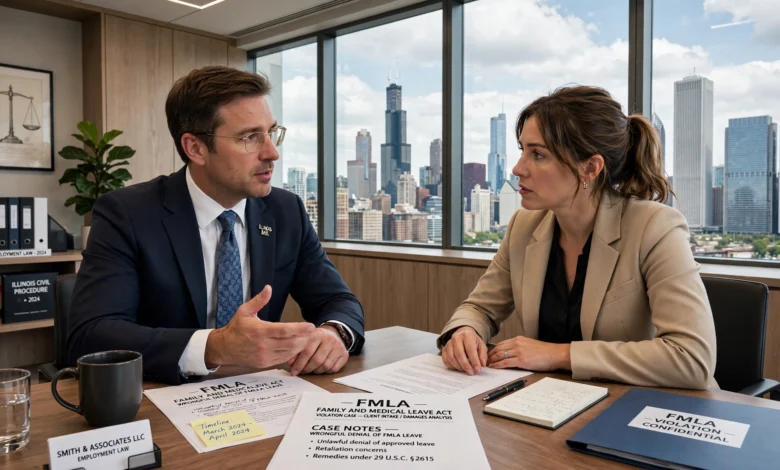
Chicago FMLA violations are far more common than most employees assume, and they often go unreported simply because workers don’t recognize what’s happening to them. If you’ve asked your employer for time off to care for a sick parent, recover from surgery, or bond with a new baby and been met with a flat “no,” a demotion, or sudden write-ups, you may have already experienced one.
The Family and Medical Leave Act is supposed to protect your job while you handle a genuine family or medical crisis, but plenty of employers in Chicago and across Illinois either don’t understand the law or choose to ignore it because they assume employees won’t push back.
This article breaks down what counts as an illegal denial of FMLA leave, the most common tactics employers use to get around the law, how Illinois’ own leave statutes add extra protection on top of the federal law, and what steps to take if you think your rights have been violated. Whether you’re trying to figure out if what happened to you was actually legal, or you already know something’s wrong and want to understand your options, this guide walks through the practical side of FMLA violations in Chicago in plain language, not legal jargon.
Leave laws are technical, and the line between a legitimate denial and an unlawful one isn’t always obvious. That’s exactly why so many valid claims never get filed. Let’s look at what the law actually requires and where employers most often cross the line.
What the FMLA Actually Guarantees Chicago Employees
The Family and Medical Leave Act (FMLA) is a federal law passed in 1993 that gives eligible employees up to 12 weeks of unpaid, job-protected leave in a 12-month period for specific family and medical reasons. According to the <cite index=”12-1″>U.S. Department of Labor, the FMLA applies to all public agencies, all public and private elementary and secondary schools, and companies with 50 or more employees</cite>, and it requires that group health benefits continue during the leave.
To qualify for FMLA protection, you generally need to meet three conditions. The <cite index=”12-1″>U.S. Department of Labor states that employees are eligible for leave if they have worked for their employer at least 12 months, at least 1,250 hours over the past 12 months, and work at a location where the company employs 50 or more employees within 75 miles</cite>.
If you meet those thresholds, you can use FMLA leave for reasons that include:
- The birth of a child, or to bond with a newborn within the first year
- The placement of a child through adoption or foster care
- Caring for a spouse, child, or parent with a serious health condition
- Your own serious health condition that makes you unable to perform your job
- Certain “qualifying exigencies” tied to a family member’s military deployment
- Caring for a covered servicemember with a serious injury (up to 26 weeks in a single 12-month period)
The point of the law isn’t just to let you take time off. It’s to guarantee that your job, or an equivalent one, is waiting for you when you get back, and that your employer can’t punish you, demote you, or push you out for having used leave you were legally entitled to.
Who Isn’t Covered, and Why That Confuses So Many Workers
Not every employee is protected, and this is where a lot of honest confusion starts. Small employers with fewer than 50 workers within 75 miles are often exempt entirely. Employees who haven’t hit the 12-month or 1,250-hour mark aren’t yet eligible. Part-time and seasonal workers frequently fall short of the hours requirement even after a year on the job.


This matters because employers sometimes use eligibility rules as cover for what is actually an illegal denial. Just because your employer says “you don’t qualify” doesn’t mean that’s true. Eligibility calculations get miscounted all the time, particularly hours worked, especially for employees who’ve had irregular schedules, unpaid time off, or a recent transfer between locations.
Common Chicago FMLA Violations Employers Commit
Most FMLA violations don’t look like an employer standing up and announcing “we’re breaking the law.” They’re subtler than that, and they’re usually dressed up to look like ordinary business decisions. Here are the patterns that show up most often in Chicago workplaces.
1. Outright Denial of a Valid Leave Request
The most direct violation is simply telling an eligible employee “no” when they request leave for a qualifying reason. Sometimes this comes with an excuse (“we’re short-staffed,” “you haven’t been here long enough,” “we need you for this project”), and sometimes it’s blunt. Under the law, none of those excuses hold up if the employee actually meets the eligibility requirements and the reason for leave qualifies.
2. Failing to Notify Employees of Their FMLA Rights
Many workers never even find out they had a right to protected leave because their employer never told them. This is a violation in itself. <cite index=”6-1″>It is a violation of the FMLA to fail to notify or inform an employee of his or her FMLA rights once the employer has notice of any condition that may qualify the employee for leave</cite>. If you told your manager about a serious diagnosis, a pregnancy, or a parent’s declining health, and nobody in HR ever mentioned FMLA paperwork, that silence can itself be unlawful.
3. Interference With the Right to Take or Return From Leave
Interference is a broad category, and it covers a lot of ground. It includes discouraging an employee from applying for leave, making the process so confusing or burdensome that it effectively blocks the request, or pressuring someone to cut their leave short. It’s also illegal for employers to force employees back to work before they are medically cleared to return, regardless of how much the business “needs” them back on the floor.
4. Retaliation for Requesting or Taking Leave
Retaliation is one of the most frequently litigated FMLA issues, and it can take many forms, including:
- Termination shortly after a leave request or return from leave
- Demotion or reduction in job responsibilities
- Cutting pay, hours, or overtime opportunities
- Reassignment to a less desirable role or shift
- A sudden wave of negative performance reviews after years of good ones
- Exclusion from meetings, projects, or promotions the employee was previously on track for
A useful thing to understand here is that you often don’t need direct proof of discriminatory intent. As one Illinois employment attorney’s site explains, in FMLA retaliation claims the employee generally doesn’t need to prove the employer acted with discriminatory intent, and a “no-fault” attendance policy won’t shield an employer if FMLA-protected time off was counted against the employee in a termination decision.
5. Refusing to Reinstate an Employee After Leave
The FMLA requires that an employee returning from qualifying leave be restored to the same job or an equivalent one with the same pay, benefits, and other employment terms. Employers sometimes get around this by claiming the position was “eliminated” or “restructured” while the employee was out, then quietly filling a nearly identical role with someone else.
6. Counting FMLA Leave Against Attendance Policies
Point-based or “no-fault” attendance systems are common in warehouses, call centers, retail, and healthcare settings around Chicago. When an employer counts FMLA-protected absences as points toward a write-up or termination, that’s a violation, even if the policy technically applies to everyone the same way.
7. Improper Certification Demands
Employers are allowed to request medical certification to support a leave request, but there are limits. Requiring excessive documentation, demanding recertification more often than the law allows, or rejecting a certification that meets the legal standard just to stall the process are all forms of unlawful interference.
Illinois Leave Laws That Go Beyond the Federal FMLA
Chicago employees actually have more protection than the federal FMLA provides on its own, because Illinois has stacked several state leave laws on top of it. Understanding these matters because an employer denying leave might be violating state law even in situations where federal FMLA doesn’t technically apply.
- Victims’ Economic Security and Safety Act (VESSA): Gives Illinois employees leave to address domestic violence, sexual assault, or stalking, including time to seek medical treatment, counseling, or legal protection.
- Illinois Family Bereavement Leave Act: Extends unpaid leave for the loss of a family member, including a child, and covers certain pregnancy-related losses like miscarriage or failed adoption.
- Illinois Employee Sick Leave Act and Paid Leave for All Workers Act: Requires many Illinois employers to provide paid leave that can be used for personal illness or to care for a family member, separate from FMLA.
- Illinois Family Medical Leave Insurance groundwork: State lawmakers have continued expanding paid leave protections, and Illinois’ rules on employer size and coverage are, in some respects, broader than the federal FMLA threshold.
If your employer denied you leave and you don’t quite meet the federal FMLA’s eligibility bar, it’s still worth checking whether an Illinois-specific law covers your situation, because the state’s rules don’t always mirror the federal ones exactly.
Real Warning Signs You’re Dealing With an Illegal FMLA Denial
It helps to know the practical signals, not just the legal definitions. If any of the following happened to you, it’s worth taking seriously:
- Your manager’s attitude toward you noticeably shifted right after you mentioned a medical issue or a family caregiving need.
- You were told you “don’t qualify” for leave without anyone actually checking your hours or tenure.
- HR never gave you any FMLA paperwork after you disclosed a serious health condition.
- You were pressured to use vacation or personal days instead of FMLA leave, without being told you had a choice.
- You returned from leave to find your job had changed, your hours were cut, or you were reassigned somewhere worse.
- You were disciplined or fired under an attendance policy that counted days you were out on FMLA leave.
- You were told to “just work from home” or answer emails during what should have been protected leave.
None of these alone proves a violation happened, but together, or even individually in the right context, they’re strong signs that something illegal took place.
What to Do If You Think Your FMLA Rights Were Violated
If you suspect your employer denied your leave illegally, acting quickly and methodically makes a real difference in how strong your case will be.
Step 1: Document Everything
Save every email, text message, and written communication about your leave request. Keep copies of pay stubs, performance reviews, and any medical documentation you submitted. If a conversation happened verbally, write down what was said, who said it, and when, as soon as you can after it happens.
Step 2: Request Everything in Writing
If your employer denies your leave, ask them to put the denial and the reason for it in writing. This creates a paper trail and makes it much harder for an employer to later claim a different reason for the decision.
Step 3: Escalate Internally, But Don’t Sign Anything You’re Unsure About
Try raising the issue with HR if you haven’t already. Sometimes a denial is a genuine mistake that gets corrected once someone above your direct manager reviews it. That said, be cautious about signing severance agreements, “performance improvement plans,” or any document your employer presents after a leave dispute without having a lawyer look at it first.
Step 4: Know Your Filing Deadlines
FMLA claims aren’t like some other employment claims that require you to file with an agency first. You generally have the right to go straight to federal court. But there are strict time limits: two years from the date of the violation, or three years if the violation was willful. Waiting too long can cost you the ability to bring a claim at all, so don’t sit on it.
Step 5: Talk to an Employment Attorney
FMLA cases hinge on details: exact hours worked, the timing of communications, how similar situations were handled for other employees, and whether the employer’s stated reason for a decision holds up against the evidence. An experienced Chicago employment attorney can evaluate whether what happened to you meets the legal standard for interference, denial, or retaliation, and can help you understand realistic outcomes before you commit to anything.
What Compensation Looks Like in a Successful FMLA Claim
Employees who win FMLA claims aren’t just vindicated on principle. The law provides for real financial remedies, including:
- Back pay for wages and benefits lost because of the violation
- Liquidated damages, often equal to the amount of actual monetary loss, effectively doubling the recovery in many cases
- Front pay in situations where reinstatement isn’t practical
- Reinstatement to the same or an equivalent position
- Attorneys’ fees and court costs, which shifts the financial burden away from the employee
These remedies exist because Congress wanted the FMLA to have real teeth. An employer that denies leave illegally isn’t just risking an awkward conversation with HR; it’s risking a lawsuit that can be expensive to lose.
Why So Many Chicago FMLA Violations Go Unreported
A lot of employees who experience an unlawful denial never do anything about it, and it’s usually not because they don’t care. It’s because they assume fighting a large employer is hopeless, they’re afraid of retaliation on top of the retaliation they’ve already faced, or they simply don’t realize what happened to them was actually illegal in the first place. Chicago has a dense mix of large employers, hospital systems, manufacturing plants, and corporate headquarters, all of which are technically covered by the FMLA, yet violations still happen at every level, from front-line warehouse jobs to white-collar management roles.
Understanding your rights is the first real step toward holding an employer accountable. You don’t need to already have a filed complaint or a lawyer on retainer to start documenting what’s happening and asking questions. The earlier you start paying attention to the pattern, the stronger your position will be if it turns out your employer really did cross a legal line.
Frequently Asked Questions
Can my employer fire me while I’m on FMLA leave? Generally, no, if the termination is because of the leave itself. Employers can still terminate employees for reasons unrelated to their leave, such as a documented, pre-existing performance issue or a company-wide layoff that would have happened regardless of the leave. The key question is always whether the leave was a motivating factor in the decision.
Does my employer have to pay me while I’m on FMLA leave? FMLA leave itself is unpaid. However, Illinois’ paid leave laws, employer policies, or short-term disability benefits may provide pay during some or all of the leave period, separate from the FMLA’s job protection.
What if my employer says the company is “too small” for FMLA to apply? Check the actual employee count within a 75-mile radius of your worksite, not just your specific location. Employers sometimes miscount or misrepresent this number. Also check whether an Illinois state leave law might apply even where federal FMLA doesn’t.
How long do I have to file an FMLA lawsuit? Two years from the date of the violation for most claims, or three years if the violation was willful.
Can I be denied FMLA leave for a mental health condition? No. A serious mental health condition that makes you unable to perform your essential job functions qualifies the same way a physical condition would, as long as it meets the FMLA’s definition of a serious health condition.
Conclusion
Chicago FMLA violations take many forms, from a flat denial of a valid leave request to quieter tactics like failing to inform employees of their rights, counting protected absences against attendance policies, or retaliating against workers once they return. Federal law guarantees eligible employees up to 12 weeks of job-protected leave for serious health conditions, new children, and family caregiving needs, and Illinois’ own leave statutes add further protection on top of that.
If you’ve noticed warning signs like a sudden change in how you’re treated at work, a denial that doesn’t add up, or discipline tied to time you were legally entitled to take off, documenting everything and speaking with an employment attorney early gives you the best chance of holding your employer accountable and recovering what you’re owed.