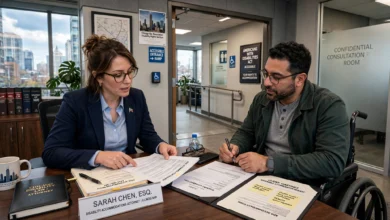
New York Disability Discrimination: ADA Rights in the Workplace
New York disability discrimination is illegal under the ADA. Learn your workplace rights, accommodations, and how to file a claim.

Facing New York disability discrimination at work is more common than most people realize, and a lot of employees don’t know how much protection the law actually gives them. Whether it’s a manager who won’t approve a reasonable accommodation, a hiring committee that quietly passes over a qualified applicant, or a coworker environment that’s turned hostile because of a medical condition, the line between a bad workday and an actual legal violation isn’t always obvious.
This article breaks down what ADA rights look like in practice for New York workers, how state and city law stack on top of federal protections, and what steps to take if you think you’ve been treated unfairly because of a disability.
New York is one of the strongest states in the country for disability protections. Between the Americans with Disabilities Act (ADA), the New York State Human Rights Law (NYSHRL), and the New York City Human Rights Law (NYCHRL), employees here have overlapping layers of coverage that often go further than federal law alone. That matters, because the ADA only applies to employers with 15 or more workers, while New York’s own laws cover businesses with as few as four employees, and New York City’s law covers nearly every employer within the five boroughs.
Understanding where these laws overlap, where they diverge, and what your employer is legally required to do is the first step toward protecting yourself. Below, we’ll go through the full picture: who’s protected, what counts as discrimination, how reasonable accommodation requests work, and what your options are if things go wrong.
What Counts as New York Disability Discrimination Under the ADA?
Disability discrimination happens whenever an employer treats a qualified employee or job applicant unfavorably because of a physical or mental impairment. Under Title I of the ADA, this protection applies to every stage of employment, not just hiring or firing.
Specifically, the ADA prohibits discrimination in:
- Job application procedures and interviews
- Hiring and promotion decisions
- Termination and layoffs
- Pay and compensation
- Job training and professional development
- Fringe benefits, such as health insurance or leave policies
- Any other term, condition, or privilege of employment
To be protected, you generally need to be a “qualified individual with a disability,” meaning you can perform the essential functions of the job with or without a reasonable accommodation. The ADA defines a disability broadly: a physical or mental impairment that substantially limits one or more major life activities, a documented history of such an impairment, or being regarded by an employer as having one. Conditions like diabetes, epilepsy, depression, anxiety disorders, cancer in remission, and mobility impairments can all qualify, even when they’re episodic or well-managed.
One detail people often miss: you don’t need to disclose every detail of a diagnosis to be protected. Employers are legally barred from asking whether you have a disability during the hiring process. They can only ask whether you’re able to perform the essential functions of the role, as confirmed by the U.S. Department of Labor.
Who Is Protected: ADA, NYSHRL, and NYCHRL Compared
New York workers actually have three overlapping layers of legal protection, and knowing the differences matters if you’re deciding where to file a complaint.


Federal Protection: The ADA
The ADA applies to private employers, labor unions, and employment agencies with 15 or more employees. It also covers state and local governments through Title II. This is the baseline protection available to most American workers, and it sets the minimum standard that state and local laws build on.
New York State Human Rights Law (NYSHRL)
As of February 2020, New York State law prohibits disability discrimination by all employers, regardless of size. Before that amendment, the law only applied to businesses with four or more employees. This change closed a major gap, since a huge share of small businesses in New York fall below the ADA’s 15-employee threshold. The NYSHRL is also interpreted more broadly than the ADA in several respects, including how it defines disability and what qualifies as a reasonable accommodation.
New York City Human Rights Law (NYCHRL)
If you work within the five boroughs, the NYCHRL adds another layer, often described as the most employee-friendly disability discrimination law in the country. It applies to employers with four or more employees and is generally interpreted even more liberally than state or federal law when it comes to what counts as a disability and what an employer must do to accommodate it.
Why this matters: if your employer has fewer than 15 employees, you may not have a federal ADA claim, but you very likely still have a claim under New York State or New York City law. Many employment attorneys advise checking all three before assuming you have no case.
Common Forms of Disability Discrimination in New York Workplaces
Disability discrimination doesn’t always look like an outright refusal to hire someone. It often shows up in smaller, harder-to-prove patterns. Common examples include:
- Refusing to hire or promote a qualified applicant because of a known or perceived disability
- Denying reasonable accommodations that would let an employee perform their job
- Paying disabled employees less or denying them the same benefits as coworkers in comparable roles
- Asking illegal medical questions during interviews or requiring medical exams unrelated to job duties
- Creating a hostile work environment through harassment, mockery, or exclusion tied to a disability
- Segregating disabled employees from other staff or client-facing roles
- Applying different performance standards to employees with disabilities than to their peers
- Retaliating against an employee who requested an accommodation or filed a complaint
- Failing to maintain confidentiality of medical information shared with HR or management
- Physical barriers in the workplace that prevent access, such as inaccessible restrooms or entryways
Even actions that seem well-meaning can cross the line. Reassigning someone to a “less stressful” role without asking them first, for example, can still count as discrimination if it’s based on assumptions about what a disabled employee can handle rather than an actual conversation about their needs and preferences.
Your Right to Reasonable Accommodation
One of the most important pieces of ADA rights in the workplace is the right to request a reasonable accommodation. Employers with 15 or more employees are required to provide reasonable accommodations for the known physical or mental limitations of a qualified employee or applicant, unless doing so would create an undue hardship for the business.
What Reasonable Accommodations Can Look Like
Accommodations vary depending on the job and the individual’s needs, but common examples include:
- Modified or flexible work schedules
- Remote work or hybrid arrangements
- Assistive technology or specialized equipment
- Physical modifications to a workspace, such as ergonomic furniture or accessible entrances
- Additional unpaid leave for medical treatment or recovery
- Reassignment to a vacant position the employee is qualified for
- Adjusted supervisory methods, such as written instructions instead of verbal ones
- Permission to bring a service animal to work
What “Undue Hardship” Actually Means
Employers can deny an accommodation only if they can show it would cause significant difficulty or expense given the size, resources, and structure of the business. This is a genuinely high bar. A large corporation, for instance, generally can’t claim undue hardship for a low-cost accommodation like a modified schedule or an ergonomic chair. Employers must rely on current medical knowledge and objective evidence, not assumptions, when evaluating whether an accommodation is workable.
The Interactive Process: How Accommodation Requests Should Work
When you request an accommodation, your employer is legally expected to engage in what’s called the “interactive process.” This is a back-and-forth conversation meant to identify an accommodation that works for both sides.
- You make the request. This doesn’t need to include specific legal language. Simply telling your employer that you have a medical condition affecting your work and need adjustments is usually enough to trigger the process.
- The employer gathers information. They may ask for documentation from a healthcare provider confirming the need for accommodation, though they cannot demand your full medical history.
- Both sides discuss options. The employer should explore accommodations together with you, not simply announce a decision.
- The employer implements the accommodation or offers a reasonable alternative if the original request isn’t feasible.
- The process continues if circumstances change or the accommodation isn’t working as intended.
If an employer ignores your request, drags it out indefinitely, or denies it without a legitimate reason, that alone can form the basis of a discrimination claim, separate from whether you were ultimately terminated or demoted.
Recognizing Retaliation
Retaliation is one of the most frequently reported violations tied to disability discrimination, and it’s illegal under the ADA, NYSHRL, and NYCHRL alike. You’re protected from retaliation if you:
- Request a reasonable accommodation
- File a complaint with HR, the EEOC, or a state agency
- Participate in a discrimination investigation as a witness
- Oppose a practice you reasonably believe is discriminatory
Retaliation can be obvious, like a sudden termination right after a complaint, or subtle, like a demotion, a shift change, exclusion from meetings, or a suddenly cold relationship with a supervisor. Courts generally look at timing closely: if adverse treatment follows shortly after a protected action, that timing itself can become evidence.
Steps to Take If You Experience Disability Discrimination in New York
If you believe you’ve experienced workplace discrimination tied to a disability, here’s a general roadmap:
- Document everything. Keep records of relevant emails, performance reviews, accommodation requests, and any denials or negative treatment, along with dates and names.
- Report internally first, if it feels safe to do so. Many companies have HR policies requiring internal reporting before external complaints, and a documented internal complaint can strengthen a later claim.
- File with the appropriate agency. You generally have a few options:
- The Equal Employment Opportunity Commission (EEOC) for federal ADA claims, with a filing deadline of 300 days from the discriminatory act in New York
- The New York State Division of Human Rights (DHR) for NYSHRL claims
- The New York City Commission on Human Rights (CCHR) for NYCHRL claims
- Consider going straight to court. Under the NYSHRL, you have the option of filing directly in state court instead of going through the DHR first.
- Consult an employment attorney. Disability discrimination cases often hinge on details, like whether an accommodation request was properly documented or whether retaliation timing lines up. An attorney experienced in New York employment law can help you figure out which laws apply and which venue gives you the strongest case.
You can find detailed guidance on the federal complaint process directly through the U.S. Equal Employment Opportunity Commission, which oversees ADA enforcement nationwide.
What Employers Are Legally Prohibited From Doing
To make the picture clearer, here’s a rundown of actions that are flatly illegal under disability discrimination law in New York:
- Refusing to hire a qualified applicant because of a disability
- Firing or demoting an employee because of a disability, rather than performance
- Denying a reasonable accommodation without demonstrating undue hardship
- Asking whether a candidate has a disability during an interview
- Requiring a medical exam that isn’t job-related
- Disclosing an employee’s medical information without consent
- Creating or tolerating a hostile work environment based on disability
- Paying disabled workers less for equal work
- Retaliating against someone for requesting accommodations or filing a complaint
New York State and City Protections That Go Beyond the ADA
New York’s state and city laws don’t just lower the employer size threshold, they also tend to define “disability” more broadly than federal law. Under the NYCHRL in particular, courts have interpreted disability to include almost any impairment, regardless of severity, and have placed a heavier burden on employers to prove undue hardship. This means that even workers who might not qualify as having a “disability” under the strict federal standard often still have protection under city or state law.
Additionally, the NYSHRL was amended in recent years to extend protections against discrimination and harassment to nearly all workplaces statewide, closing loopholes that previously left smaller employers unregulated. For New York employees, this layered system generally means more paths to relief and, in many cases, longer filing windows and broader remedies than federal law alone would provide.
Why Working With an Employment Attorney Matters
Disability discrimination cases are rarely as simple as “I was fired because of my condition.” Employers almost never state a discriminatory reason outright. Instead, cases usually come down to circumstantial evidence: shifting explanations, suspicious timing, comparisons to how non-disabled coworkers were treated, and whether the interactive process was handled properly.
An experienced New York employment attorney can help you:
- Determine which laws apply to your specific employer and situation
- Evaluate whether your employer’s denial of an accommodation was legally justified
- Identify the strongest venue for your claim, whether that’s the EEOC, DHR, CCHR, or state court
- Preserve and organize evidence before it’s lost or altered
- Negotiate a settlement or represent you through litigation if needed
Most employment attorneys who handle these cases offer free initial consultations, and many work on contingency, meaning you don’t pay unless you recover damages.
Conclusion
New York disability discrimination remains a serious and often underreported problem, but the legal protections available to employees here are unusually strong compared to the rest of the country. Between the ADA, the New York State Human Rights Law, and the New York City Human Rights Law, most workers have multiple avenues of protection, whether their employer has 4 employees or 4,000.
Knowing your rights, including the right to reasonable accommodation, the right to a fair and confidential interactive process, and the right to be free from retaliation, puts you in a much stronger position if a problem arises. If you believe you’ve experienced discrimination, documenting the details early and speaking with an employment attorney familiar with New York law is the most reliable way to understand your options and protect your career.