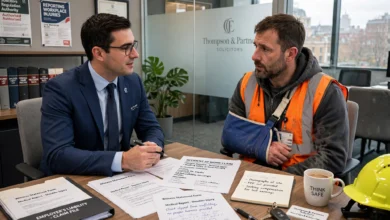
Manchester Work Injury Solicitors: No Win No Fee Workplace Claims
Manchester work injury solicitors explain how no win no fee workplace claims work, what you can claim for, and how to start your case.

Getting hurt at work turns an ordinary day upside down. Between hospital visits, missed wages, and the stress of not knowing what comes next, the last thing anyone wants to think about is legal paperwork. That’s exactly why Manchester work injury solicitors exist, to take the legal weight off your shoulders while you focus on getting better.
Manchester has always been a working city. From warehouses and construction sites near the Trafford Park estate to offices, hospitals, and factories scattered across Greater Manchester, thousands of people go to jobs every day that carry some level of risk. When an employer cuts corners on safety, or a colleague makes a careless mistake, the person who pays the price is usually the worker.
This article walks through how no win no fee workplace claims actually work, what you can expect to claim for, how long you have to act, and what to look for in a solicitor who knows the Manchester area and its employers well. Whether you slipped on a wet warehouse floor, injured your back lifting stock, or were hurt operating machinery, the goal here is to give you a clear, honest picture before you pick up the phone to anyone.
What Manchester Work Injury Solicitors Actually Do
Manchester work injury solicitors specialise in representing employees who have been hurt while doing their jobs. Their work covers a lot more than just filling out forms. A good solicitor will:
- Investigate exactly how the accident happened, including gathering witness statements and safety records
- Obtain your medical records and arrange an independent medical assessment if needed
- Calculate the true cost of your injury, both financial and personal
- Deal directly with your employer’s insurer, so you don’t have to negotiate alone
- Negotiate a fair settlement or, if necessary, take the case to court
Because these solicitors work almost exclusively in personal injury and employment-related claims, they know how insurers think and how to counter the tactics used to reduce or delay payouts. That local knowledge matters too. A solicitor based in or around Manchester will often already understand which industries in the region see the most workplace accidents, from logistics and construction firms in Salford to manufacturing sites in Oldham and Bolton.
Understanding No Win No Fee Workplace Claims
The phrase no win no fee gets used loosely, so it’s worth explaining what it actually means in a legal sense. The formal name is a Conditional Fee Agreement (CFA). Under this arrangement, your solicitor agrees to handle your workplace injury claim without charging you legal fees upfront. If the claim doesn’t succeed, you typically don’t pay your solicitor’s fees at all.
How Conditional Fee Agreements Work
A CFA is a written contract between you and your solicitor that sets out:
- The circumstances under which fees become payable (usually only on a successful claim)
- The “success fee”, a percentage the solicitor takes from your compensation if you win, capped by law at 25% of the general damages and past financial losses awarded
- What happens to any expenses, such as medical report costs, incurred along the way
This structure exists so that people don’t have to weigh up their legal rights against their bank balance. Before the CFA became common practice, many injured workers simply couldn’t afford to challenge their employer, even when they had a strong case. The no win no fee model changed that by shifting the financial risk onto the solicitor rather than the client.
What Happens If You Lose
This is the part people worry about most, and it’s a fair concern. Most reputable Manchester work injury solicitors will also arrange After the Event (ATE) insurance alongside your CFA. This insurance covers the other side’s legal costs and any disbursements if your claim is unsuccessful, so you’re not left out of pocket. Always ask your solicitor to confirm in writing exactly what is and isn’t covered before you sign anything. A transparent firm will explain this without hesitation.


Common Types of Workplace Injuries in Manchester
Workplace accidents vary hugely depending on the industry, but certain patterns show up again and again. According to <cite index=”9-1″>HSE data, slips, trips or falls on the same level account for around 30% of non-fatal workplace injuries, with handling, lifting or carrying making up roughly 17%, followed by being struck by a moving object at 10%</cite>.
The most common categories solicitors in Manchester deal with include:
- Slips, trips, and falls caused by wet floors, loose cables, or poor lighting in warehouses and offices
- Manual handling injuries, such as back and shoulder strains from lifting stock or equipment without proper training or support
- Machinery accidents, particularly in manufacturing and industrial units around Trafford Park and Wythenshawe
- Falls from height, common on construction sites, which remain one of the leading causes of fatal workplace injuries nationally
- Repetitive strain injuries from prolonged, poorly supported physical tasks
- Exposure injuries, including burns, chemical exposure, or respiratory problems from inadequate ventilation
- Vehicle and forklift accidents in logistics and distribution centres, an industry with a strong presence across Greater Manchester
Every one of these injury types can form the basis of a workplace injury claim, provided it can be shown that the employer failed in their duty of care, whether through poor training, faulty equipment, insufficient staffing, or ignoring known hazards.
How Much Compensation Can You Claim
There’s no single figure that applies to every case, because compensation depends on the severity of the injury, its impact on your life, and your financial losses. That said, compensation claims for workplace injuries are generally broken down into two categories.
General Damages
This covers the pain, suffering, and loss of enjoyment of life caused by the injury. Solicitors and courts refer to guideline figures published by the Judicial College when estimating this amount, adjusting up or down based on how severe and long-lasting the injury is.
Special Damages
This covers your actual financial losses, which can include:
- Lost earnings, both past and future, if your injury affects your ability to work
- Medical costs, including private treatment, physiotherapy, or prescriptions
- Travel expenses to appointments
- Care costs, if you needed help at home during recovery
- Cost of adapting your home or vehicle for a long-term or permanent injury
A serious injury that leaves someone unable to return to their previous job can result in a much larger claim than a minor injury that heals within weeks, simply because the future financial impact is so much greater. This is one of the main reasons it’s worth speaking to a solicitor even if your injury seems relatively minor at first. Some injuries, particularly to the back or joints, don’t reveal their full long-term effect for months.
Time Limits for Workplace Injury Claims
In England and Wales, you generally have three years from the date of the accident, or from the date you became aware your injury was linked to your work, to start a workplace injury claim. This time limit is known as the limitation period, and there are a few important exceptions:
- For children injured at work, the three-year clock doesn’t start until their 18th birthday
- For claimants who lack the mental capacity to manage their own affairs, there may be no time limit at all
- For industrial disease claims, such as hearing loss or lung conditions that develop gradually, the three years often runs from the date of diagnosis rather than the date of exposure
Missing this deadline usually means losing the right to claim altogether, which is why early legal advice matters. It also gives your solicitor more time to gather evidence while memories and records are still fresh, which tends to strengthen the case.
Steps to Making a No Win No Fee Claim
The claims process is more straightforward than most people expect. Here’s roughly what to expect when working with Manchester work injury solicitors:
- Initial consultation – You explain what happened, usually free of charge, and the solicitor assesses whether you have a viable claim
- Signing the CFA – Once the solicitor agrees to take your case, you sign the no win no fee agreement
- Evidence gathering – Your solicitor collects medical records, accident reports, CCTV footage, and witness statements
- Notifying the employer’s insurer – A formal letter of claim is sent, setting out the basis of the claim
- Medical assessment – An independent medical expert examines your injury and produces a report used to value the claim
- Negotiation – Most claims settle at this stage, with the insurer making an offer that your solicitor will either accept, reject, or negotiate further
- Court proceedings, if needed – Only a small percentage of claims actually reach a courtroom; most are resolved through negotiation
Throughout this process, your solicitor should keep you updated at each stage and explain any offers made in plain language, not legal jargon, so you can make an informed decision about whether to accept.
Choosing the Right Manchester Work Injury Solicitor
Not every solicitor is the right fit for every case. When comparing firms, it helps to look for a few specific things:
- Regulation – Confirm the firm is regulated by the Solicitors Regulation Authority (SRA), which sets professional standards for legal practice in England and Wales
- Experience with workplace claims specifically, rather than general personal injury work alone
- Clear fee structure, with the success fee percentage and any ATE insurance costs explained upfront
- Track record locally, since a solicitor familiar with Manchester’s major employers and industries will often anticipate how a case is likely to unfold
- Communication style – You want a solicitor who returns calls and explains things clearly, not one who leaves you chasing updates
- Reviews and testimonials from previous clients, ideally verified through independent platforms rather than only the firm’s own website
A short phone consultation is usually enough to get a feel for whether a firm is being straightforward with you or just trying to sign you up quickly. Trust your instincts here; the solicitor you choose will be handling a sensitive and often stressful part of your life.
Employer Responsibilities and Your Rights
Every employer in the UK has a legal duty of care toward their staff under the Health and Safety at Work Act 1974. This includes providing proper training, maintaining safe equipment, carrying out risk assessments, and reporting serious incidents under RIDDOR (the Reporting of Injuries, Diseases and Dangerous Occurrences Regulations). You can read more about employer duties directly from the <cite index=”9-1″>Health and Safety Executive</cite>, which publishes detailed guidance and annual statistics on workplace injury reporting.
Making a claim against your employer doesn’t mean you’re doing anything wrong, and by law, employers cannot legally dismiss or penalise you for pursuing a genuine workplace injury claim. Nearly all employers in the UK are required to carry Employers’ Liability Insurance, which means the claim is generally paid by the insurer, not out of the employer’s own pocket. This is worth remembering if you’re hesitant to come forward out of loyalty to your workplace or fear of awkwardness with colleagues.
If you’re unsure of your rights as an employee, independent guidance is also available through the government’s own resources on making a personal injury claim, which explain the legal process in more general terms.
Why Local Manchester Expertise Matters
Manchester’s economy is a genuine mix of old and new industry, warehousing and logistics around the M60 corridor, construction tied to the city’s ongoing regeneration projects, healthcare, retail, and a growing number of office-based and tech employers in the city centre. A solicitor who works regularly within this region tends to have a sharper understanding of:
- Which local insurers and employer representatives are commonly involved in claims
- How Greater Manchester’s courts and medical assessment centres typically operate
- Industry-specific safety standards relevant to warehousing, construction, or manufacturing
- Practical matters like arranging medical assessments close to where you live, reducing travel during recovery
This local knowledge doesn’t replace legal skill, but it does tend to make the process smoother and faster, particularly when a case needs a strong understanding of how a specific type of workplace typically operates.
Conclusion
Being injured at work is stressful enough without worrying about legal costs or whether you can afford to challenge your employer’s insurer. Manchester work injury solicitors working on a no win no fee basis exist to remove that financial barrier, allowing genuine claims to be pursued without upfront risk to the injured worker. From slips and manual handling injuries to serious falls and machinery accidents, the claims process follows a clear path: get medical treatment, gather evidence, seek advice within the three-year time limit, and let an experienced solicitor deal with the insurer on your behalf.
Choosing a solicitor with strong local knowledge of Manchester’s industries, a transparent fee structure, and a track record of clear communication puts you in the strongest position to secure the compensation your injury and recovery actually deserve.