Boston Workplace Injuries: Massachusetts Workers Comp vs Third-Party Claims
Boston workplace injuries can trigger two separate claims. Learn how Massachusetts workers comp and third-party lawsuits differ and work together.
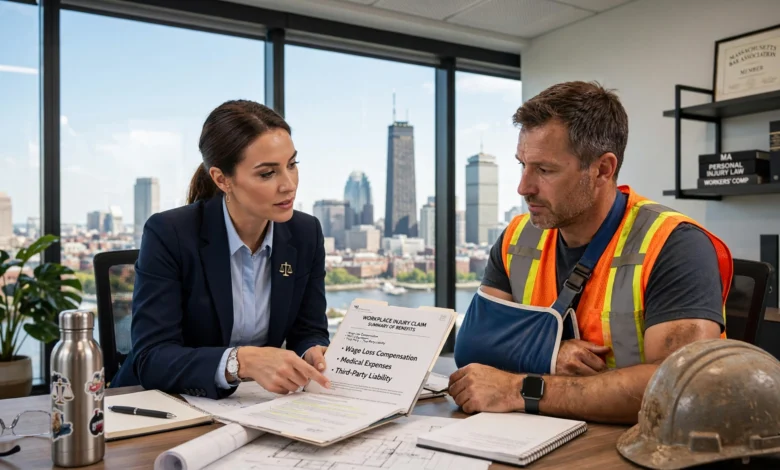
Boston workplace injuries put thousands of people out of work every year, and most of them assume workers’ compensation is their only option. It isn’t. If someone other than your employer had a hand in causing the accident, you may be able to file a second claim on top of your workers’ comp benefits, one that can recover money workers’ comp was never designed to pay.
That distinction matters because the two systems work in completely different ways. Massachusetts workers compensation is a no-fault system. You don’t have to prove anyone did anything wrong to get medical bills paid and a portion of your wages replaced. A third-party claim, on the other hand, is a personal injury lawsuit. It requires proving negligence, but it opens the door to compensation for pain and suffering, full lost wages, and other losses that workers’ comp simply doesn’t cover.
For construction workers, delivery drivers, warehouse employees, and anyone hurt on a job site involving outside contractors or equipment, understanding how these two paths intersect can be the difference between a modest settlement and one that actually reflects what the injury cost them. This guide breaks down how each claim works, who qualifies for a third-party case, and how the two systems interact once both are in play, including the lien reimbursement issue that catches so many injured workers off guard.
Understanding Massachusetts Workers’ Compensation Basics
Workers’ compensation in Massachusetts is governed by Massachusetts General Laws Chapter 152. Nearly every employer in the state is required to carry workers’ comp insurance, and nearly every employee is covered from their first day on the job, regardless of immigration status, full-time or part-time hours, or how long they’ve worked there.
The core trade-off of the system is simple: employees give up the right to sue their employer directly for a workplace injury, and in exchange, they get guaranteed benefits without having to prove the employer was careless. You could trip over your own feet on a wet floor you spilled yourself and still qualify for benefits.
What Workers’ Comp Actually Pays For
Massachusetts workers’ compensation benefits generally include:
- Medical treatment related to the injury, including doctor visits, surgery, physical therapy, and prescriptions
- Temporary total disability benefits, typically around 60 percent of your average weekly wage while you’re unable to work
- Temporary partial disability benefits if you can work in a limited capacity but earn less than before
- Permanent disability benefits for injuries that leave lasting impairment
- Death benefits for surviving dependents in fatal workplace accidents
What Workers’ Comp Does Not Cover
This is where most injured workers get an unpleasant surprise. Workers’ compensation does not pay for:
- Pain and suffering
- Emotional distress
- Loss of enjoyment of life
- The full amount of your lost income (only a percentage, and only up to a state-mandated cap)
- Punitive damages in cases involving egregious conduct
If your injury was serious and someone outside your employer contributed to it, that gap is exactly where a third-party claim comes in.
What Counts as a Third-Party Claim in Massachusetts
A third-party claim is a standard personal injury lawsuit filed against someone other than your employer or a coworker acting within the scope of their job. Massachusetts law specifically preserves this right. Under Chapter 152, Section 15, when an injury happens “under circumstances creating a legal liability in some person other than the insured,” an injured worker can pursue both workers’ comp benefits and a separate claim against that responsible party.


Unlike workers’ comp, a third-party case requires proving negligence: that the third party owed you a duty of care, breached that duty, and caused your injuries as a result. That’s a higher legal bar, but it comes with a much wider range of recoverable damages.
Common Sources of Third-Party Liability
Boston’s job sites, especially in construction, involve layers of contractors, subcontractors, property owners, and equipment suppliers, any of whom could bear some responsibility for an accident. Common third-party scenarios include:
- General contractors or subcontractors other than your direct employer who created a hazard on a shared job site
- Property owners who failed to maintain safe premises
- Equipment and machinery manufacturers whose defective products caused an injury
- Drivers of other vehicles if you were hurt in a work-related car or truck accident
- Maintenance or service companies contracted to inspect or repair equipment
- Utility companies responsible for exposed wiring, gas lines, or similar hazards
Why Construction Sites Generate So Many Third-Party Cases
Construction work carries a disproportionate share of Massachusetts workplace injuries, and it’s also where third-party claims come up most often. A single site might have a general contractor, several subcontractors, an equipment rental company, and a property owner, all operating at once. If a crane operator employed by a different subcontractor drops a load on you, or a piece of rented scaffolding collapses due to a manufacturing defect, your own employer’s workers’ comp policy pays your basic benefits, but the negligent party can be pursued separately for everything else.
Massachusetts law also imposes a non-delegable duty on general contractors to keep a construction site reasonably safe, which means a general contractor can sometimes be held liable even if the specific hazard was created by a subcontractor’s crew.
Boston Workplace Injuries: How the Two Claims Work Together
One of the most misunderstood parts of this process is that filing a third-party claim doesn’t cancel out your workers’ comp benefits. You’re generally entitled to pursue both. What changes is how the money gets divided once a third-party settlement or verdict comes through.
The Workers’ Comp Lien
When your workers’ comp insurer pays out medical bills and wage replacement, and you later recover money from a third-party lawsuit for that same injury, the insurer typically has a right to reimbursement from your settlement. This is called a workers’ comp lien. It exists so you don’t collect twice for the same losses.
The math here matters. A skilled attorney can often negotiate the lien down, particularly by accounting for legal fees and costs, or by arguing that certain portions of the settlement (like pain and suffering) shouldn’t be subject to reimbursement at all. Handling this poorly can mean a settlement that looks substantial on paper but leaves the injured worker with far less than expected after the lien is paid.
Sequencing the Claims
In practice, most injured workers:
- File the workers’ comp claim first to secure immediate medical coverage and wage replacement
- Investigate whether a third party contributed to the accident
- File the third-party lawsuit within the applicable deadline
- Resolve the lien reimbursement as part of any third-party settlement or verdict
Because these processes overlap and the reimbursement calculation can get complicated, coordinating both claims with the same legal strategy in mind tends to produce a better outcome than treating them as unrelated matters.
Deadlines You Cannot Afford to Miss
Massachusetts imposes different deadlines depending on which claim you’re filing, and missing either one can permanently close the door on compensation.
- Workers’ compensation claims: Under General Laws Chapter 152, Section 41, a claim generally must be filed within four years of the injury, or from when the employee first recognized the connection between a disability and their job. In practice, injuries should be reported to an employer immediately, since delays can complicate the claim.
- Third-party personal injury lawsuits: Massachusetts generally applies a three-year statute of limitations for personal injury claims, running from the date of the accident or, in some cases, from when the injury was discovered.
Because the third-party deadline is shorter and less forgiving, it’s worth having any potential third-party liability evaluated as early as possible, ideally soon after the accident, rather than waiting until the workers’ comp claim is fully resolved.
Comparative Negligence and Your Third-Party Case
Massachusetts follows a modified comparative negligence rule for personal injury claims. If you’re found partially at fault for your own accident, your compensation is reduced by your percentage of fault. If you’re found more than 50 percent at fault, you’re generally barred from recovering anything at all.
This matters because third parties and their insurers will often try to shift blame back onto the injured worker, or argue that the employer, who can’t be sued directly, was actually the responsible party. That’s a common defense tactic, and it’s one reason third-party cases tend to be more contested and slower to resolve than straightforward workers’ comp claims.
Common Boston Workplace Injuries That Involve Third Parties
Certain types of accidents show up in third-party cases more often than others:
- Falls from scaffolding, ladders, or roofs on multi-contractor job sites
- Struck-by accidents involving cranes, forklifts, or falling materials operated by another company’s crew
- Defective tools or machinery that malfunction due to a manufacturing or design flaw
- Vehicle collisions during work-related travel or deliveries
- Electrocution or gas exposure tied to utility company negligence
- Unsafe premises conditions on job sites not controlled by your direct employer
If your injury falls into one of these categories, it’s worth having the circumstances reviewed specifically for third-party liability, even if your workers’ comp claim has already been accepted and is moving forward without issue.
Why the Distinction Matters for Your Recovery
The practical difference between relying only on workers’ comp and pursuing both claims can be significant. Workers’ comp caps wage replacement at a percentage of your average weekly wage and offers nothing for pain and suffering. A successful third-party claim can fill both of those gaps, along with compensation for permanent impairment, disfigurement, and the broader impact an injury has on your life.
That said, not every workplace injury involves a viable third-party claim. Plenty of accidents genuinely stem only from ordinary workplace risk with no outside negligence involved, and in those cases, workers’ comp remains the sole avenue for recovery. The key is not assuming either way. A careful review of how the accident happened, who else was present, what equipment was involved, and who controlled the site is the only reliable way to know whether a second claim exists.
Steps to Take After a Boston Workplace Injury
- Report the injury to your employer immediately, in writing if possible, to start the workers’ comp process correctly.
- Seek medical treatment and keep records of every visit, diagnosis, and treatment plan.
- Document the scene with photos, witness names, and details about equipment or other companies present.
- Avoid giving recorded statements to any insurance company, including a third party’s insurer, without understanding how it could affect your case.
- Have the accident reviewed for third-party liability before assuming workers’ comp is your only option.
- Track every deadline, since the third-party statute of limitations runs independently of your workers’ comp claim.
For official guidance on filing a workers’ compensation claim, the Massachusetts Department of Industrial Accidents publishes forms, filing procedures, and information about the claims and appeals process. The U.S. Bureau of Labor Statistics also tracks national workplace injury and fatality data, which offers useful context for how common these accidents are across industries like construction.
Conclusion
Boston workplace injuries don’t always have to be resolved through workers’ compensation alone. While Massachusetts workers’ comp provides fast, no-fault medical and wage benefits, it stops well short of covering the full financial and personal toll of a serious injury. When a third party, whether a subcontractor, property owner, equipment manufacturer, or another driver, contributed to the accident, a separate personal injury claim can recover damages that workers’ comp was never built to provide, including pain and suffering and full lost income.
The two systems can run alongside each other, but they involve different proof requirements, different deadlines, and a lien reimbursement process that needs careful handling to protect your net recovery. Reviewing the specific facts of your accident early, before either deadline closes, is the best way to find out whether you’re leaving compensation on the table.